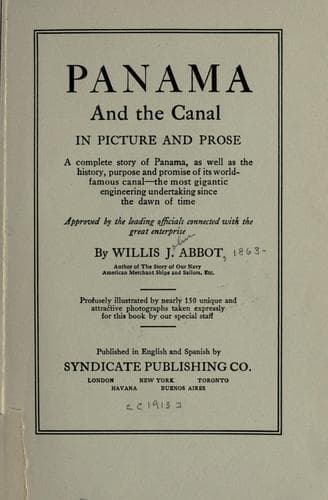
Panama and the Canal in Picture and ProseAbbot, Willis J. (Willis John)
History
Panama and the Canal in Picture and Prose
Abbot, Willis J. (Willis John)
Panama Canal (Panama) -- History
The plan was simplicity itself and was defeated by an equally simple
mischance. The drinks of the Isthmus which, as we have seen, the
Spaniards commended mightily when they drank, were treacherous in their
workings upon the human mind--a quality which has not passed away with
the buccaneers and cimmaroons, but still persists. One of Drake’s jolly
cutthroats, being over fortified with native rum for his nocturnal
vigil, heard the tinkle of mule bells and rose to his feet. The leading
muleteer turned his animal and fled, crying to the saints to protect him
from the sheeted specter in the path. The captain in charge of the
caravan was dubious about ghosts, but, there being a number of mules
loaded with grain at hand, concluded to send them on to see if there
were anything about the ghosts which a proper prayer to the saint of the
day would exorcise. So the Englishmen again heard the tinkling mule
bells, waited this time in low breathing silence to let the rich prize
pass, then with shouts of triumph dashed from the jungle, cut down or
shot the luckless muleteers, and swarmed about the caravan eager to cut
the bags and get at the booty--and were rewarded with sundry bushels of
grain intended to feed the crowds at Nombre de Dios.
[Illustration: A LADY OF THE SAVANNA]
The disaster was irreparable. The true treasure train at the first
uproar had fled back to the walls of Panama. Nothing was left to Drake
and his men but to plod back empty handed to Cruces, where they had
left their boats. Of course they raided the town before leaving but the
season was off and the warehouses barren. Back they went to the coast
and relieved their feelings by ransacking a few coastwise towns and
hurling taunts at the governor of Cartagena. Shortly thereafter they
renewed their enterprise and did this time capture the treasure train,
getting perhaps $100,000 worth of plunder, with but little loss. Some
French pirates under Captain Tetu, who had joined in the adventure,
suffered more severely and their captain, wounded and abandoned in the
forest, was put to death by the Spaniards with certain of their favorite
methods of torture.
[Illustration: NATIVE CHILDREN, PANAMA PROVINCE]
After a time in England Drake returned to the Caribbean with a
considerable naval force, harried the coast, burned and sacked some
towns, including Nombre de Dios, and obtained heavy ransom from others.
He put into the harbor of Porto Bello, with the intent of taking it
also, but while hesitating before the formidable fortresses of the place
was struck down by death. His body, encased in lead, was sunk in the bay
near perhaps to the ancient ships which our dredges have brought to
light. The English long revered him as a great sailor and commander,
which he was, though a reckless adventurer. His most permanent influence
on the history of the Isthmus was his demonstration that Nombre de Dios
was incapable of defense, and its consequent disappearance from the map.
Public-domain text, read in full here on John Shaqi.
Reviews
Reviews
No reviews yet
Be the first to share your thoughts on this work.
Elsewhere in the archive
Join the Discussion
Join the discussion
Sign in to leave a comment or review.
Sign InorCreate an account