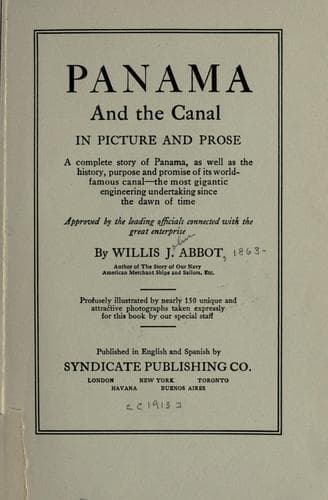
Panama and the Canal in Picture and ProseAbbot, Willis J. (Willis John)
History
Panama and the Canal in Picture and Prose
Abbot, Willis J. (Willis John)
Panama Canal (Panama) -- History
Such greatness as had pertained to Nombre de Dios was soon assumed by
Porto Bello, which soon grew far beyond the size attained by its
predecessor. It became indeed a substantially built town, and its
fortresses on the towering heights on either side of the beautiful bay
seemed fit to repel any invader--notwithstanding which the town was
repeatedly taken by the English. Even today the ruins of town and forts
are impressive, more so than any ruins readily accessible on the
continent, though to see them at their best you must be there when the
jungle has been newly cut away, else all is lost in a canopy of green.
Across the bay from the town, about a mile and a half, stand still the
remnants of the “Iron Castle” on a towering bluff, Castle Gloria and
Fort Geronimo. These defensive works were built of stone, cut from reefs
under the water found all along the coast. Almost as light as pumice
stone and soft and easily worked when first cut, this stone hardens on
exposure so that it will stop a ball without splitting or chipping. When
Admiral Vernon, of the British navy, had captured the town in 1739, he
tried to demolish the fort and found trouble enough. “The walls of the
lower battery,” he recorded, “consisting of 22 guns, were nine foot
thick and of a hard stone cemented with such fine mortar that it was a
long work to make any impression in it, to come to mine at all, so that
the blowing up took sixteen or eighteen days.” Even today the relics of
the Iron Fort present an air of bygone power and the rusty cannon still
lying by the embrasures bring back vividly the days of the buccaneers.
Inheriting the greatness and prosperity of Nombre de Dios, Porto Bello
inherited also its unpleasant prominence as a target for the sea rover.
French filibusters and various buccaneers raided it at their fancy,
while the black Cimmaroons of the mainland lay in wait for caravans
entering or leaving its gates. To describe, or even to enumerate, all
the raids upon the town would be wearisome to the reader. Most savage,
however, of the pests that attacked the place was Sir Henry Morgan, the
Welsh buccaneer, whose exploits are so fully and admiringly related by
Esquemeling that we may follow his narrative, both of the sack of Porto
Bello, and the later destruction of the Castle of San Lorenzo.
[Illustration: BULL-RIDER AND NATIVE CAR AT BOUQUETTE, CHIRIQUI]
Public-domain text, read in full here on John Shaqi.
Reviews
Reviews
No reviews yet
Be the first to share your thoughts on this work.
Elsewhere in the archive
Join the Discussion
Join the discussion
Sign in to leave a comment or review.
Sign InorCreate an account