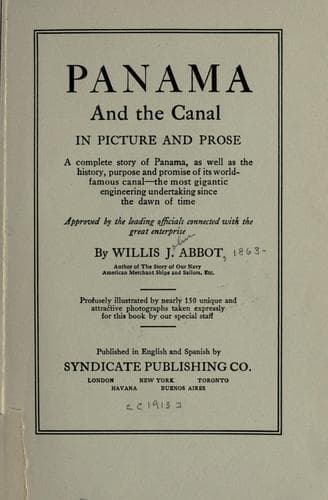
Panama and the Canal in Picture and ProseAbbot, Willis J. (Willis John)
History
Panama and the Canal in Picture and Prose
Abbot, Willis J. (Willis John)
Panama Canal (Panama) -- History
It was in 1668 that Morgan made his first attack upon Porto Bello.
“Here,” wrote Esquemeling, “are the castles, almost inexpugnable, that
defend the city, being situated at the entry of the port; so that no
ship or boat can pass without permission. The garrison consists of three
hundred soldiers, and the town is constantly inhabited by four hundred
families, more or less. The merchants dwell not here, but only reside
for awhile, when the galleons come or go from Spain; by reason of the
unhealthiness of the air, occasioned by certain vapors that exhale from
the mountains. Notwithstanding their chief warehouses are at Porto
Bello, howbeit their habitations be all the year long at Panama; whence
they bring the plate upon mules at such times as the fair begins, and
when the ships, belonging to the Company of Negroes, arrive here to sell
slaves.”
Morgan’s expedition consisted of nine ships and about 460 men, nearly
all British--too small a force to venture against such a stronghold. But
the intrepid commander would listen to no opposition. His ships he
anchored near Manzanillo Island where now stands Colon. Thence by small
boats he conveyed all save a few of his men to a point near the landward
side of the town, for he feared to attack by sea because of the great
strength of the forts. Having taken the Castle of Triana he resolved to
shock and horrify the inhabitants of the town by a deed of cold-blooded
and wholesale murder, and accordingly drove all the defenders into a
single part of the castle and with a great charge of gunpowder
demolished it and them together. If horrified, the Spaniards were not
terrified, but continued bravely the defense of the works they still
held. For a time the issue of the battle looked dark for Morgan, when to
his callous and brutal mind there occurred an idea worthy of him alone.
Let us follow Esquemeling’s narrative again:
[Illustration: THE INDIANS CALL HER A WITCH]
Public-domain text, read in full here on John Shaqi.
Reviews
Reviews
No reviews yet
Be the first to share your thoughts on this work.
Elsewhere in the archive
Join the Discussion
Join the discussion
Sign in to leave a comment or review.
Sign InorCreate an account