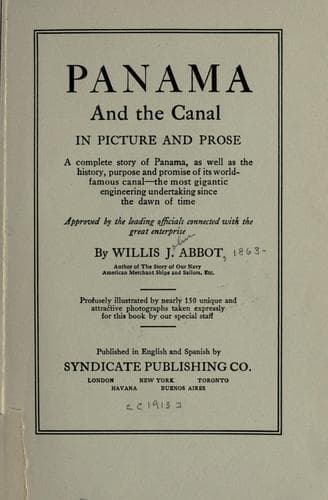
Panama and the Canal in Picture and ProseAbbot, Willis J. (Willis John)
History
Panama and the Canal in Picture and Prose
Abbot, Willis J. (Willis John)
Panama Canal (Panama) -- History
“Live about two days if he couldn’t find the trail or the river’s bank,”
was the response of the Man Who Knew. “If he lived longer he’d live
crazy. Torn by thorns, often poisoned, bitten by venomous insects,
blistered by thirst, with the chances against his finding any fruit that
was safe eating, he would probably die of the pain and of jungle madness
before starvation brought a more merciful death. The jungle is a cat
that tortures its captives; a python that embraces them in its graceful
folds and hugs them to death; a siren whose beauty lured them to
perdition. Look out for it.”
The native Indian knows it and avoids it by doing most of his traveling
by canoe. On our trip to the river’s mouth we passed many in their
slender cayucas, some tied by a vine to the bank patiently fishing,
others on their way to or from market with craft well loaded with
bananas on the way up, but light coming back, holding gay converse with
each other across the dark and sullen stream. Here and there through
breaks in the foliage we see a native house, or a cluster of huts, not
many however, for the jungle is too thick and the land too low here for
the Indians who prefer the bluffs and occasional broad savannas of the
upper waters. As we approach its outlet the river, about fifty or sixty
yards wide thus far, broadens into a considerable estuary, and rounding
a point we see before us the blue Atlantic breaking into white foam on a
bar which effectually closes the river to all save the smallest boats,
and which you may be sure the United States will never dredge away, to
open a ready water-way to the base of the Gatun locks. To the left
covering a low point, level as if artificially graded, is a beautiful
cocoanut grove, to the right, across a bay perhaps a quarter of a mile
wide is a native village of about fifty huts with an iron roofed church
in the center--beyond the village rises a steep hill densely covered
with verdure, so that it is only by the keenest searching that you can
pick out here a stone sentry tower, there the angle of a massive
wall--the ruins of the Castle of San Lorenzo.
[Illustration: OLD SPANISH MAGAZINE]
“Cloud crested San Lorenzo guards
The Chagres entrance still,
Though o’er each stone the moss hath grown
And earth his moat doth fill.
His bastions feeble with decay
Steadfastly view the sea,
And sternly wait the certain fate
The ages shall decree.”
[Illustration: SPANISH RUINS, PORTO BELLO]
Public-domain text, read in full here on John Shaqi.
Reviews
Reviews
No reviews yet
Be the first to share your thoughts on this work.
Elsewhere in the archive
Join the Discussion
Join the discussion
Sign in to leave a comment or review.
Sign InorCreate an account