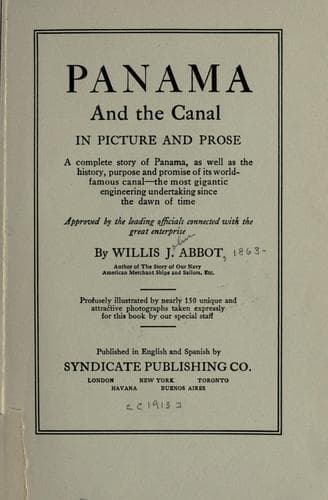
Panama and the Canal in Picture and ProseAbbot, Willis J. (Willis John)
History
Panama and the Canal in Picture and Prose
Abbot, Willis J. (Willis John)
Panama Canal (Panama) -- History
We land in the cocoanut grove across the river from the ruins we have
come to see and the uninitiated among us wonder why. It appears however
that the descendants of the natives who so readily surrendered dominion
of the land to the Spaniards are made of sterner stuff than their
ancestors. Or perhaps it was because we had neither swords or
breastplates that they reversed the 16th century practice and extorted
tribute of silver from us for ferrying us across the stream in cayucas
when our own boats and boat-men would have given us a greater sense of
security. Landed in the village we were convoyed with great ceremony to
the alcalde’s hut where it was demanded that we register our names and
places of residence. Perhaps that gave us a vote in the Republic of
Panama, but we saw no political evidences about unless a small saloon,
in a hut thatched with palmetto leaves and with a mud floor and basket
work sides might be taken for a “headquarters”. Indeed the saloon and a
frame church were about the only signs of civilization about the town if
we except a bill posted in the alcalde’s office setting forth the
mysterious occult powers of a wizard and soothsayer who, among other
services to mankind, recounted a number of rich marriages which had been
made by the aid of his philters and spells.
[Illustration: OUR GUIDE AT SAN LORENZO]
We made our way from the village attended by volunteer guides in the
scantiest of clothing, across a little runway at the bottom of a ravine,
and so into the path that leads up the height crowned by the castle. It
was two hundred and fifty years ago, almost, that the little hollow ran
with a crimson fluid, and the bodies of dead Spaniards lay in the
rivulet where now the little native boys are cooling their feet. The
path is steep, rugged and narrow. Branches arch overhead and as the
trail has served as a runway for the downpour of innumerable tropical
rains the soil is largely washed away from between the stones, and the
climbing is hard.
[Illustration: THE AUTHOR AT SAN LORENZO]
“Not much fun carrying a steel helmet, a heavy leather jacket and a
twenty-pound blunderbuss up this road on a hot day, with bullets and
arrows whistling past,” remarks a heavy man in the van, and the picture
he conjures up of the Spanish assailants on that hot afternoon in 1780
seems very vivid. Although the fort, the remains of which are now
standing, is not the one which Morgan destroyed, the site, the natural
defenses and the plan of the works are identical. There was more wood in
the original fort than in that of which the remains are now
discernible--to which fact its capture was due.
[Illustration: LOOKING UP THE CHAGRES FROM SAN LORENZO]
Public-domain text, read in full here on John Shaqi.
Reviews
Reviews
No reviews yet
Be the first to share your thoughts on this work.
Elsewhere in the archive
Join the Discussion
Join the discussion
Sign in to leave a comment or review.
Sign InorCreate an account