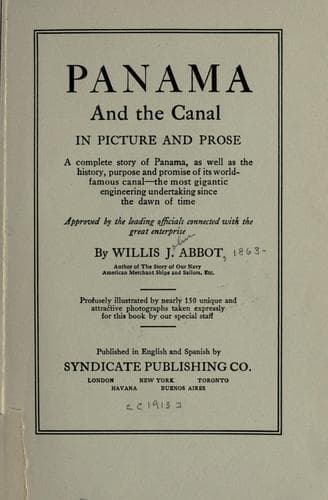
Panama and the Canal in Picture and ProseAbbot, Willis J. (Willis John)
History
Panama and the Canal in Picture and Prose
Abbot, Willis J. (Willis John)
Panama Canal (Panama) -- History
Its heavy walls show that it was planned for defense but the Spaniards
abandoned it]
[Illustration: _Photo by Burtis & Elliott_
THE RUINED TOWER OF SAN AUGUSTINE]
The country round about Panama was then, and still is, arable and
well-fitted for grazing. The rural population was but small, more meager
indeed than one would think would have been necessary for raising
vegetables for so considerable a town. In the back country were great
numbers of Cimmaroons, or escaped slaves who are described as living in
communities, ruled over by a black king. They went naked and were armed
with bows and arrows, spears, darts and machetes. They lived on plunder
and as when captured were they killed, or, at the best, enslaved anew,
they fought with great desperation. Merchandise trains were their chief
victims, though they often raided cattle ranches, or cut off individuals
in the outskirts of the city. The English supplied them with weapons and
could always be sure of their aid against the Spaniards, who had been
their masters and whom they hated.
The harbor was wretched, useful only for small vessels which at high
tide could come straight to the seawall, being left there by the
receding tide, high and dry, so that by quick action they could be
unloaded before the waters returned. A very considerable part of the
food of the town was fish brought thither by Indians from Taboga and
nearby islands.
Such was the town which Morgan raided. Because of the colossal disaster
which befell it, a disaster without parallel since the days when the
Goths and Vandals swept down over the pleasant plains of Italy, there
has been a tendency to magnify the size, wealth and refinement of Panama
at the time of its fall. But studied calmly, with no desire to
exaggerate the qualities which made it so rich a prize, Panama may
fairly be described as a city of about 30,000 people, with massive
churches, convents and official buildings of masonry, with many stately
houses of the type esteemed luxurious in the tropics, and peopled
largely by pure-blooded Spaniards of the better type. It was too early
a date for the amalgamation of races now so much in evidence on the
Isthmus to have proceeded far, and the ancient records show that the
Spaniards of substance in the town had mainly come thither from Seville.
Public-domain text, read in full here on John Shaqi.
Reviews
Reviews
No reviews yet
Be the first to share your thoughts on this work.
Elsewhere in the archive
Join the Discussion
Join the discussion
Sign in to leave a comment or review.
Sign InorCreate an account