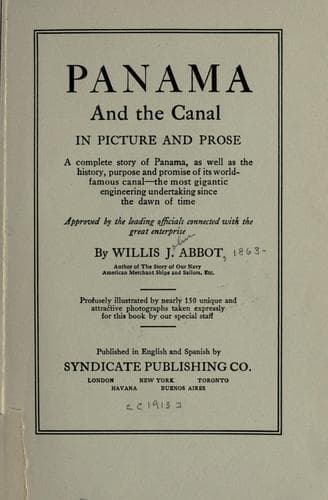
Panama and the Canal in Picture and ProseAbbot, Willis J. (Willis John)
History
Panama and the Canal in Picture and Prose
Abbot, Willis J. (Willis John)
Panama Canal (Panama) -- History
Morgan started up the river from San Lorenzo, where he left 500 men to
serve as a garrison, on the 18th of January, 1761. His force comprised
1200 men in five boats with artillery and thirty-two canoes. The raiders
planned to live on the country and hence took small store of
provisions--an error which nearly wrecked the expedition. The first day
they covered about eighteen miles. This was by nature made the easiest
part of their journey, for this stretch of the Chagres is deep, with but
a slow current and much of the way they may have been aided by the
incoming tide. If the chronicler who fixed their distance covered at
eighteen miles was correct, they must have pitched their camp the first
night not very far from where Gatun Dam now rears its mighty bulk across
the valley and makes of the Chagres a broad lake. Their troubles however
came with their first nightfall. Leaving their boats and scattering
about the surrounding country they found that the Spaniards had raked it
clean of provisions of every sort. The Indian villages were either
smoking ruins or clusters of empty huts, the cattle ranches were bare of
cattle, and even the banana and yam patches were stripped. By noon on
the second day, according to Esquemeling, “they were compelled to leave
their boats and canoes by reason the river was very dry for want of
rain, and the many trees that were fallen into it.” Henceforth at that
point the Chagres River transformed into a lake will be in the
neighborhood of forty feet deep the year round. Apparently, however, the
abandonment of the boats was only partial, the main body of troops
marching through the woods while others waded, pushing the boats over
the shallows as is done today. The advance was continued in this
fashion, partly by water and partly through the jungle, all with the
greatest difficulty, at a snail’s pace and on stomachs daily growing
emptier. Twice they came upon signs that the Spaniards had prepared an
ambuscade for them, but becoming faint-hearted had fled. Thereat the
buccaneers grumbled mightily. They were better at fighting than at
chopping paths through the jungle, and were so hungry that if they had
slain a few Spaniards they would quite probably have cooked and eaten
them. For six days they struggled with the jungle without finding any
food whatsoever, then they discovered a granary stored with maize which
they ate exultingly. Leather scraps became a much prized article of
food, just as in a very different climate Greely’s men in the Arctic
circle kept alive on shreds cut from their sealskin boots. Of leather as
an article of diet Esquemeling writes:
[Illustration: WAYSIDE SHRINE ON THE SAVANNA ROAD]
Public-domain text, read in full here on John Shaqi.
Reviews
Reviews
No reviews yet
Be the first to share your thoughts on this work.
Elsewhere in the archive
Join the Discussion
Join the discussion
Sign in to leave a comment or review.
Sign InorCreate an account