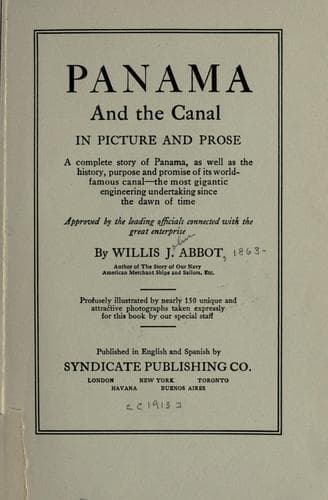
Panama and the Canal in Picture and ProseAbbot, Willis J. (Willis John)
History
Panama and the Canal in Picture and Prose
Abbot, Willis J. (Willis John)
Panama Canal (Panama) -- History
From this point onward the invaders saw many of their enemies, but the
Indians only offered active resistance, firing upon the advancing column
from ambuscades, and at one or two made a determined stand. As the
invaders were strung out in single file along a narrow road (Esquemeling
complains that only ten or twelve men could walk in a file) it would
have been easy to so impede their progress, and harass them with attacks
from the bush, as to defeat their purpose wholly. For it is to be
remembered that the English were almost starved, footsore and weary,
dragging cannon along the rocky roads and bearing heavy equipment under
the scorching sun. But the Spaniards contented themselves with shouting
defiance and daring the invaders to meet them “a la savanna.” At the
first danger of a fight they ran away.
Gaining on the ninth day of their march the top of a hill, still known
as “El Cerro de los Buccaneeros” (The Hill of the Buccaneers), the
pirates had the joy of seeing for the first time the Pacific, and thus
knowing that Panama must be at hand. Upon the plain below they came upon
a great body of cattle. Some historians say that the Spaniards had
gathered a great herd of savage bulls to be driven upon the English
lines in expectation of putting them to rout. The tradition seems
doubtful, and to any one who has seen the mild and docile bulls of the
Panama savannas it is merely ridiculous. However the cattle came there
it was an ill chance for the Spaniards, for they furnished the hearty
food necessary to put fight again into the famished bodies of the
buccaneers. Esquemeling’s description of the banquet on the plains is
hardly appetizing:
[Illustration: ARCHED BRIDGE AT OLD PANAMA, ALMOST 400 YEARS OLD
There was no Horatius to hold this strait path against the invaders]
“Here while some were employed in killing and flaying cows, horses,
bulls and chiefly asses, of which there was greatest number, others
busied themselves in kindling of fires and getting wood wherewith to
roast them. Thus cutting the flesh of these animals into pieces, or
gobbets, they threw them into the fire, and half carbonadoed or roasted,
they devoured them with incredible haste and appetite. For such was
their hunger that they more resembled cannibals than Europeans at this
banquet, the blood many times running down from their beards to the
middle of their bodies.”
Gorged to their gullets, the cutthroats lay down to rest. Morgan had a
sharp watch kept, and sounded at least one false alarm that the men
might not sleep too securely. But the Spaniards on the eve of their
crushing disaster left their foes to rest in peace except for a noisy
cannonade which did no damage, and shouts of “Corros! Nos
Veremos”--“Dogs! We will see you again,” which they certainly did,
finding the meeting most unpleasant.
Public-domain text, read in full here on John Shaqi.
Reviews
Reviews
No reviews yet
Be the first to share your thoughts on this work.
Elsewhere in the archive
Join the Discussion
Join the discussion
Sign in to leave a comment or review.
Sign InorCreate an account