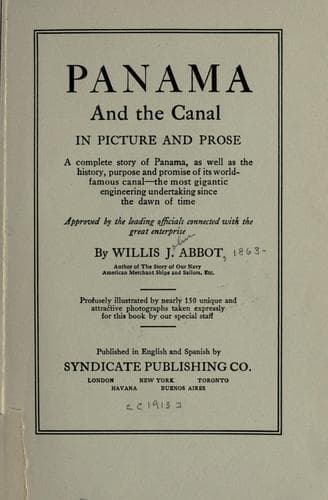
Panama and the Canal in Picture and ProseAbbot, Willis J. (Willis John)
History
Panama and the Canal in Picture and Prose
Abbot, Willis J. (Willis John)
Panama Canal (Panama) -- History
“Here again he was happy, that had reserved since noon any small piece
of leather whereof to make his supper, drinking after it a good draught
of water for his greatest comfort. Some persons, who never were out of
their mothers’ kitchens, may ask how these pirates could eat, swallow
and digest those pieces of leather, so hard and dry. To whom I only
answer: That could they once experiment what hunger, or rather famine,
is, they would certainly find the manner, by their own necessity, as the
pirates did. For these first took the leather and sliced it in pieces.
Then did they beat it between two stones, and rub it, often dipping it
in the water of the river to render it by these means supple and tender.
Lastly they scraped off the hair, and roasted or broiled it upon the
fire. And, being thus cooked, they cut it into small morsels, and eat
it, helping it down with frequent gulps of water, which by good fortune
they had near at hand.”
Once only did they meet with any resistance; that was near Cruces where
several hundred Indians ambushed them in the jungle, and while avoiding
any direct combat, killed several with arrows. As the Indians fled they
cried out in Spanish, “Ho, ye dogs! Go to the savanna; to the savanna,”
from which, as from like warnings uttered by stragglers, the invaders
concluded that battle was to be given them on the broad plain before the
city.
It had taken six days for the expedition to reach Cruces--a trip which
could readily be made today by train to Gamboa and thence by cayuca in
five or six hours. Arrived there they prepared for the last stage of the
journey, for there they finally left their boats and took up the Royal
Road. Cruces is eight miles from Panama, and at the moment of Morgan’s
descent upon it, was at the period of its greatest prosperity. Of its
rise to greatness and its final disappearance under the rising waters of
Gatun Lake I shall have more to say in the chapter concerning the
Chagres River. The English found the frame houses already ablaze, and
the larders swept clean, the Spaniards having followed their invariable
custom of leaving no food for the invaders. Some wretched dogs and cats
which hung about the deserted dwellings were killed and eaten, and in
the storehouses a number of jars of wine were found, upon drinking which
the buccaneers became deathly sick. They claimed it was poisoned, but
more probably their stomachs, which had been struggling to digest
leather scraps, were in no condition for the strong wines of the
tropics.
Public-domain text, read in full here on John Shaqi.
Reviews
Reviews
No reviews yet
Be the first to share your thoughts on this work.
Elsewhere in the archive
Join the Discussion
Join the discussion
Sign in to leave a comment or review.
Sign InorCreate an account