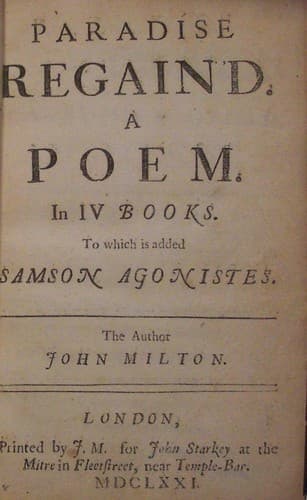
Bible. Gospels -- History of Biblical events -- Poetry; English poetry; Epic poetry; Jesus Christ -- Temptation -- Poetry
Or on the AEmilian—some from farthest south,
Syene, and where the shadow both way falls, 70
Meroe, Nilotic isle, and, more to west,
The realm of Bocchus to the Blackmoor sea;
From the Asian kings (and Parthian among these),
From India and the Golden Chersoness,
And utmost Indian isle Taprobane,
Dusk faces with white silken turbants wreathed;
From Gallia, Gades, and the British west;
Germans, and Scythians, and Sarmatians north
Beyond Danubius to the Tauric pool.
All nations now to Rome obedience pay— 80
To Rome’s great Emperor, whose wide domain,
In ample territory, wealth and power,
Civility of manners, arts and arms,
And long renown, thou justly may’st prefer
Before the Parthian. These two thrones except,
The rest are barbarous, and scarce worth the sight,
Shared among petty kings too far removed;
These having shewn thee, I have shewn thee all
The kingdoms of the world, and all their glory.
This Emperor hath no son, and now is old, 90
Old and lascivious, and from Rome retired
To Capreae, an island small but strong
On the Campanian shore, with purpose there
His horrid lusts in private to enjoy;
Committing to a wicked favourite
All public cares, and yet of him suspicious;
Hated of all, and hating. With what ease,
Endued with regal virtues as thou art,
Appearing, and beginning noble deeds,
Might’st thou expel this monster from his throne, 100
Now made a sty, and, in his place ascending,
A victor-people free from servile yoke!
And with my help thou may’st; to me the power
Is given, and by that right I give it thee.
Aim, therefore, at no less than all the world;
Aim at the highest; without the highest attained,
Will be for thee no sitting, or not long,
On David’s throne, be prophesied what will.”
To whom the Son of God, unmoved, replied:—
“Nor doth this grandeur and majestic shew 110
Of luxury, though called magnificence,
More than of arms before, allure mine eye,
Much less my mind; though thou should’st add to tell
Their sumptuous gluttonies, and gorgeous feasts
On citron tables or Atlantic stone
(For I have also heard, perhaps have read),
Their wines of Setia, Cales, and Falerne,
Chios and Crete, and how they quaff in gold,
Crystal, and myrrhine cups, imbossed with gems
And studs of pearl—to me should’st tell, who thirst 120
And hunger still. Then embassies thou shew’st
From nations far and nigh! What honour that,
But tedious waste of time, to sit and hear
So many hollow compliments and lies,
Outlandish flatteries? Then proceed’st to talk
Of the Emperor, how easily subdued,
How gloriously. I shall, thou say’st, expel
A brutish monster: what if I withal
Expel a Devil who first made him such?
Let his tormentor, Conscience, find him out; 130
For him I was not sent, nor yet to free
That people, victor once, now vile and base,
Deservedly made vassal—who, once just,
Frugal, and mild, and temperate, conquered well,
But govern ill the nations under yoke,
Peeling their provinces, exhausted all
Public-domain text, read in full here on John Shaqi.
Reviews
Reviews
No reviews yet
Be the first to share your thoughts on this work.
Join the Discussion
Join the discussion
Sign in to leave a comment or review.
Sign InorCreate an account