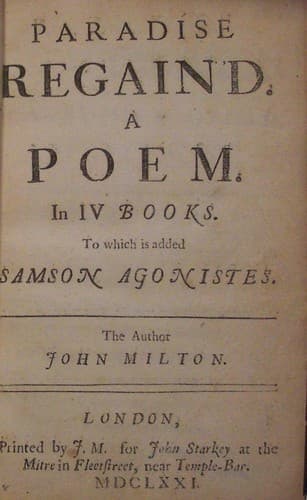
Bible. Gospels -- History of Biblical events -- Poetry; English poetry; Epic poetry; Jesus Christ -- Temptation -- Poetry
Their gods ridiculous, and themselves past shame.
Remove their swelling epithetes, thick-laid
As varnish on a harlot’s cheek, the rest,
Thin-sown with aught of profit or delight,
Will far be found unworthy to compare
With Sion’s songs, to all true tastes excelling,
Where God is praised aright and godlike men,
The Holiest of Holies and his Saints
(Such are from God inspired, not such from thee); 350
Unless where moral virtue is expressed
By light of Nature, not in all quite lost.
Their orators thou then extoll’st as those
The top of eloquence—statists indeed,
And lovers of their country, as may seem;
But herein to our Prophets far beneath,
As men divinely taught, and better teaching
The solid rules of civil government,
In their majestic, unaffected style,
Than all the oratory of Greece and Rome. 360
In them is plainest taught, and easiest learnt,
What makes a nation happy, and keeps it so,
What ruins kingdoms, and lays cities flat;
These only, with our Law, best form a king.”
So spake the Son of God; but Satan, now
Quite at a loss (for all his darts were spent),
Thus to our Saviour, with stern brow, replied:—
“Since neither wealth nor honour, arms nor arts,
Kingdom nor empire, pleases thee, nor aught
By me proposed in life contemplative 370
Or active, tended on by glory or fame,
What dost thou in this world? The Wilderness
For thee is fittest place: I found thee there,
And thither will return thee. Yet remember
What I foretell thee; soon thou shalt have cause
To wish thou never hadst rejected, thus
Nicely or cautiously, my offered aid,
Which would have set thee in short time with ease
On David’s throne, or throne of all the world,
Now at full age, fulness of time, thy season, 380
When prophecies of thee are best fulfilled.
Now, contrary—if I read aught in heaven,
Or heaven write aught of fate—by what the stars
Voluminous, or single characters
In their conjunction met, give me to spell,
Sorrows and labours, opposition, hate,
Attends thee; scorns, reproaches, injuries,
Violence and stripes, and, lastly, cruel death.
A kingdom they portend thee, but what kingdom,
Real or allegoric, I discern not; 390
Nor when: eternal sure—as without end,
Without beginning; for no date prefixed
Directs me in the starry rubric set.”
So saying, he took (for still he knew his power
Not yet expired), and to the Wilderness
Brought back, the Son of God, and left him there,
Feigning to disappear. Darkness now rose,
As daylight sunk, and brought in louring Night,
Her shadowy offspring, unsubstantial both,
Privation mere of light and absent day. 400
Our Saviour, meek, and with untroubled mind
After hisaerie jaunt, though hurried sore,
Hungry and cold, betook him to his rest,
Wherever, under some concourse of shades,
Whose branching arms thick intertwined might shield
From dews and damps of night his sheltered head;
But, sheltered, slept in vain; for at his head
The Tempter watched, and soon with ugly dreams
Disturbed his sleep.
Public-domain text, read in full here on John Shaqi.
Reviews
Reviews
No reviews yet
Be the first to share your thoughts on this work.
Join the Discussion
Join the discussion
Sign in to leave a comment or review.
Sign InorCreate an account