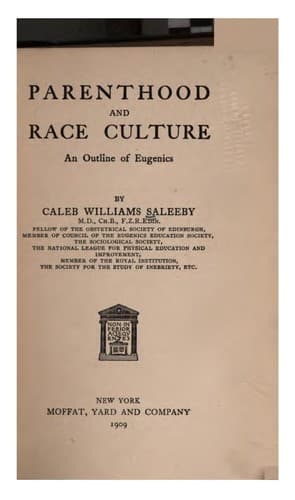
Parenthood and Race Culture: An Outline of EugenicsSaleeby, C. W. (Caleb Williams)
Philosophy
Parenthood and Race Culture: An Outline of Eugenics
Saleeby, C. W. (Caleb Williams)
Eugenics
=Heredity and environment.=--Let us consider the question in general
terms. The characters of any living thing are determined by two
factors--heredity and environment. The old phrases were character and
circumstances, but they were less than useful, since character is
modified by circumstances. Now one of the most important questions
in the world, and not least for the eugenist, is as to the relative
importance of these two factors. The technical terms may not be in
our mouths, but we discuss this instance or that of the question in
point almost every day of our lives. One part of the business of
philosophy and of science is not only to answer questions but to ask
them correctly. This question is always wrongly asked, and therefore
cannot be answered, or is incorrectly answered. We persist in using
the mathematical idea of addition, and we seek to show that, say,
seventy per cent. of the result is due to the innate factor and thirty
per cent. to the acquired. But the truth is that so long as we begin
with this idea we may prove what we please. If we keep our attention
fixed upon the environmental or educational factor we can easily and
correctly demonstrate that in certain circumstances Mozart would
have been tone-deaf and Shakespeare a gibbering idiot--hence, but
incorrectly, we argue that environment is practically everything. _Per
contra_, we can easily and correctly demonstrate that no education
in the world could enable a door-mat or a cabbage or ourselves to
write _Don Giovanni_ or _Hamlet_--hence, but incorrectly, we argue
that the material to be operated upon is everything. We have to
learn, however, that the analogy _is one not of addition but of
multiplication_. Neither inheritance nor environment, as such, gives
anything. The environmental factor may be potentially one hundred--an
ideal education--but the innate or inherited factor may be nothing, as
when the pupil is a door-mat or a fool. The result then is nothing.
Darwin had the trombone played to a plant, but he did not make a
Palestrina. No academy of music will make a beetroot into a Beethoven,
though I dare say a well-trained beetroot might write a musical comedy.
The point is that one hundred multiplied by nothing equals nothing.
Similarly, the innate factor may be one hundred, as in the case of a
potential genius, but he may be brought up upon alcohol and curses
amongst savages, and the result again is nothing. Keep the idea of
multiplication in the mind, and the facts are seen rightly. No matter
how big either factor be, if it be multiplied by nothing it yields
nothing, or if it be multiplied by a fraction, as in the ordinary
education of a genius, it yields less than it should. But in this
controversy people persist in assuming that inheritance or education
gives definitely so much which is there anyhow, whereas, really,
it only supplies a potential figure, which may realise infinity or
nothing, according to what it is multiplied by. With all deference, I
Public-domain text, read in full here on John Shaqi.
Reviews
Reviews
No reviews yet
Be the first to share your thoughts on this work.
Elsewhere in the archive
Join the Discussion
Join the discussion
Sign in to leave a comment or review.
Sign InorCreate an account