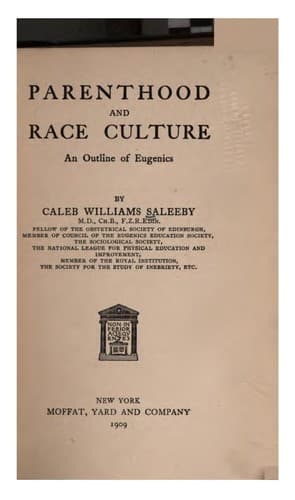
Parenthood and Race Culture: An Outline of EugenicsSaleeby, C. W. (Caleb Williams)
Philosophy
Parenthood and Race Culture: An Outline of Eugenics
Saleeby, C. W. (Caleb Williams)
Eugenics
submit this as a real answer to these endless disputes.
But further, granted that neither factor in itself produces any
actuality, which is normally the weightier of the two factors? We must
make the qualification, “normally,” because such a thing as disease or
poison, included in the environmental factor, will dominate the result,
completely overshadowing the importance of whatever heredity gave. Such
things apart, however, we may be thoroughly assured that heredity is
the weightier of the two factors. The more we study education, the more
we recognise its true nature. Indeed, the more we realise its ideal,
the more do we realise its limitations. The more we study education
the more important does heredity appear. If the reader has not had
opportunities of observing children for himself let him refer to such
a book as Mr. Galton's _Inquiries into Human Faculty_, and he will
begin to realise how large is the factor given by inheritance and how
relatively small is the factor given by education.
=Education can educate only what heredity gives.=--Heredity, as
the eugenist must never forget, gives not actualities but only
potentialities. It depends upon circumstances whether they shall
become actualities. That, however, we all know. No one supposes that
education is superfluous or impotent. We do, however, persistently
forget the converse truth that education, on the other hand, makes no
definite contribution, but merely multiplies--or alas, divides--the
potentialities given by inheritance. These potentialities constitute
a limiting condition which no education can transcend. Education can
educate only what heredity gives. Long ago Helvetius thought, as did
Kant, that the differences between men were due to differences in
education. But it is not so. We make, of course, the most ridiculous
claims for education. The remark wrongly attributed to the Duke of
Wellington, that “the battle of Waterloo was won on the playing-fields
of Eton,” is an instance in point. Recently, when Francis Thompson,
the poet, died, the local newspaper of his birthplace said that it
should be proud to have produced him. We may laugh at this conception
of the genesis of genius, but we all talk in this fashion. A genius
was educated at Eton, and we say that Eton produced him. The truth
is, of course, that Eton failed to destroy him. (One says Eton for
convenience, but the name of any accepted school will do.) If Eton
produced him, why does not it produce thousands like him? There is
plenty of material: but it is not the right material. We should
cease to speak, in our pride for our own _Alma Mater_ or our own
methods, as if education created genius or anything else. Men are born
unequal. To realise the nature of education is not only to avoid the
popular assumption that an ideal education will do everything for us,
forgetting that no amount of polishing will make pewter shine like
silver; it is not only to send us back to the principle of selection
Public-domain text, read in full here on John Shaqi.
Reviews
Reviews
No reviews yet
Be the first to share your thoughts on this work.
Elsewhere in the archive
Join the Discussion
Join the discussion
Sign in to leave a comment or review.
Sign InorCreate an account