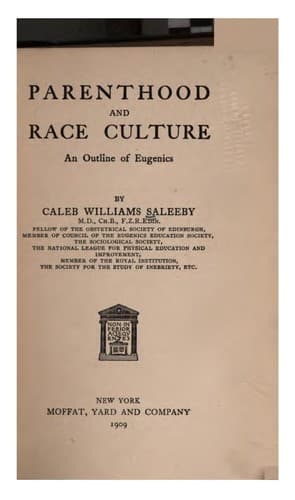
Parenthood and Race Culture: An Outline of EugenicsSaleeby, C. W. (Caleb Williams)
Philosophy
Parenthood and Race Culture: An Outline of Eugenics
Saleeby, C. W. (Caleb Williams)
Eugenics
“172. And the law about education, which is sorrowfullest to vulgar
pride, is this--that all its gains are at compound interest; so that,
as our work proceeds, every hour throws us farther behind the greater
men with whom we began on equal terms. Two children go to school hand
in hand, and spell for half an hour over the same page. Through all
their lives, never shall they spell from the same page more. One is
presently a page a-head, two pages, ten pages--and evermore, though
each toils equally, the interval enlarges--at birth nothing, at death
infinite.”
So much for one relation of this question to Socialism. Quite lately
(_The New Age_, April 11th, 1908) Mr. Havelock Ellis has summed the
matter up as follows:--
“Education has been put at the beginning, when it ought to have
been put at the end. It matters comparatively little what sort of
education we give children; the primary matter is what sort of
children we have got to educate. That is the most fundamental of
questions. It lies deeper even than the great question of Socialism
versus Individualism, and indeed touches a foundation that is
common to both. The best organised social system is only a house
of cards if it cannot be constructed with sound individuals; and
no individualism worth the name is possible, unless a sound social
organisation permits the breeding of individuals who count. On this
plane Socialism and Individualism move in the same circle.”
We cannot agree with Socialism when, as we think, it assumes that
all evil is of economic or of educational origin. The student of
heredity finds elements of evil abundant in poisoned germ-plasm and
not absent from the best. Surely, surely, the products of progress are
not mechanisms but men; and surely no economic system as such can be
the only mechanism worth naming--which would be one that made men. The
germ-plasm is such a mechanism, indeed; and hence its quality is all
important.
But if Socialism, sooner than any other party, is going to identify
itself with the economic principle of Ruskin that “there is no wealth
but life”; and if in its discussion of the conditions of industry it
will concern itself primarily with the culture of the racial life,
which is the vital industry of any people (and basis enough for a New
Imperialism, or at least a New Patriotism, that might be quite decent);
if so, then it seems to me that we must look to the socialists for
salvation. But books which describe future externals, books which
assume that education is a panacea, forgetting that education can
educate only what heredity gives, turn us away again when we are almost
persuaded. The _economic_ panacea must fail (at least as a panacea);
the _educational_ panacea must fail; the _eugenic_ panacea may not fail.
* * * * *
Public-domain text, read in full here on John Shaqi.
Reviews
Reviews
No reviews yet
Be the first to share your thoughts on this work.
Elsewhere in the archive
Join the Discussion
Join the discussion
Sign in to leave a comment or review.
Sign InorCreate an account