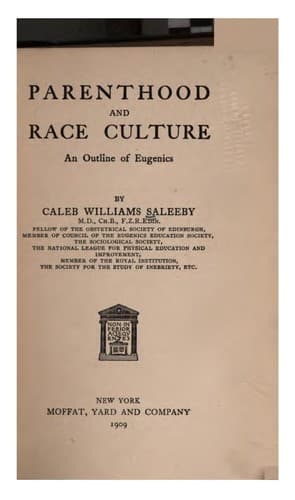
Parenthood and Race Culture: An Outline of EugenicsSaleeby, C. W. (Caleb Williams)
Philosophy
Parenthood and Race Culture: An Outline of Eugenics
Saleeby, C. W. (Caleb Williams)
Eugenics
If now we trace the history of life up to man, we find in him--as
we have seen--the lowest birth-rate of any animal and the longest
ante-natal period in proportion to his body weight, the longest
period of maternal feeding, and by far the lowest infant mortality
and general death-rate. A chief fact of progress has been, in a word,
the supersession of the quantitative by the qualitative criterion of
survival-value. Immeasurably vast vital economy and efficiency have
thus been effected. The tendency of progress, in short--a tendency
coincident with the evolution of ever higher and higher species--is to
pass from the horrible Gargantuan wastefulness of the older methods
towards the evident but yet lamentably unrealised ideal--that every
child born shall reach maturity. This great historical tendency, which
will ultimately involve the restriction of parenthood to the fit, fine
and relatively few, has occurred under the impartial rule of natural
selection simply and solely because it has endowed with survival-value
the successive species in which it has been demonstrated.
=The rise of parenthood.=--Consistently with this fact and with
the argument of the previous chapter is the tendency towards
the lengthening of infancy, a very characteristic condition of
the evolution of the higher forms of life. This lengthening and
accentuation of infancy makes for variety of development, and, as
we have seen, is supremely instanced in man, where it depends upon,
and makes possible, the transmutation of fixed instincts into the
plastic thing we call intelligence. Thus, to quote the words of Dr.
Parsons,[44] “we find that as infancy is prolonged in the progress
of species, the care given to offspring by parents is increased. It
extends over a longer period and it is directed more and more towards
the total welfare of offspring. The need of a potentially many-sided
and enduring kind of parental care is filled through the social group
we call the family.”
Apart from those immensely significant creatures, the social insects,
we find well-marked though primitive signs of motherhood amongst the
fishes, and in a few cases, such as the stickleback, the beginnings of
fatherhood. But it is not until we reach the mammals, and especially
the monkeys and apes, that we find a great development of motherhood,
far more prolonged and far more important than the more frequently
extolled parental care found amongst the birds.
Public-domain text, read in full here on John Shaqi.
Reviews
Reviews
No reviews yet
Be the first to share your thoughts on this work.
Elsewhere in the archive
Join the Discussion
Join the discussion
Sign in to leave a comment or review.
Sign InorCreate an account