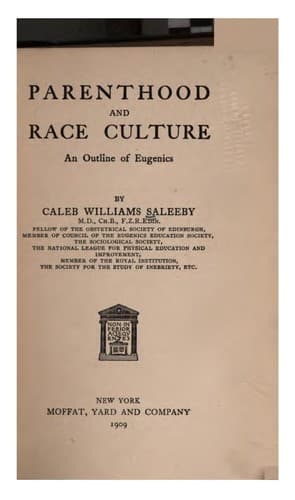
Parenthood and Race Culture: An Outline of EugenicsSaleeby, C. W. (Caleb Williams)
Philosophy
Parenthood and Race Culture: An Outline of Eugenics
Saleeby, C. W. (Caleb Williams)
Eugenics
Very interesting, however, in the case of the fishes is the fact
observed by Sutherland that “as soon as the slightest trace of parental
care is discovered the chance of survival is increased and the
birth-rate is lowered.” As a general summary these words of Dr. Parsons
will serve:--“Diminution of offspring is a threefold gain to a species.
(1) It lessens the vital drain upon the parent. (2) It enables the
size and capacity of the limited number of offspring to be increased.
(3) In the case of the higher developments of parental care after
birth, it concentrates the advantage of that care upon a few instead of
scattering it, and thereby weakening its influence, upon many.”
Now how are these facts connected with that relation between the
parents which we call marriage, temporary or permanent, foreshadowed or
perfected?
_It may be submitted that the racial function or survival-value of
marriage in all its forms, low or high, animal or human, consists in
its services to the principle of motherhood, these services depending
upon the help and strength which are afforded to motherhood by
fatherhood._
=Animal marriage.=--Let us now look very briefly at the facts of animal
marriage from this point of view. The phrase, animal marriage, may
possibly offend the reader, but is there any reason to be offended
at the suggestion that the principle of marriage actually has a
warrant older even than mankind? It has lately been pointed out by a
distinguished naturalist, Mr. Ernest Thompson Seton, that animals, like
men, have long been groping, so to say, for an ideal form of marriage.
We now know, as will be shown, that, contrary to popular opinion,
promiscuity does not prevail amongst the lowest races of men. Equally
false is the popular notion that promiscuity prevails amongst most of
the lower animals. Promiscuity, it is true, does occur, but so also
does strict monogamy, “and promiscuous animals, such as rabbits and
voles, while high in the scale of fecundity, are low in the scale of
general development.” Says Mr. Seton: “It is commonly remarked that
while the Mosaic law did not expressly forbid polygamy, it surrounded
marriage with so many restrictions that by living up to the spirit
of them the Hebrew ultimately was forced into pure monogamy. It is
extremely interesting to note that the animals, in their blind groping
for an ideal form of union, have gone through the same stages, and have
arrived at exactly the same conclusion. Monogamy is their best solution
of the marriage question, and is the rule among all the higher and most
successful animals.”
Public-domain text, read in full here on John Shaqi.
Reviews
Reviews
No reviews yet
Be the first to share your thoughts on this work.
Elsewhere in the archive
Join the Discussion
Join the discussion
Sign in to leave a comment or review.
Sign InorCreate an account