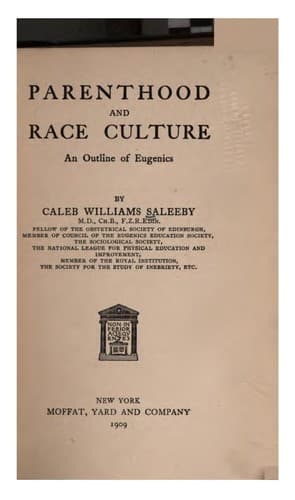
Parenthood and Race Culture: An Outline of EugenicsSaleeby, C. W. (Caleb Williams)
Philosophy
Parenthood and Race Culture: An Outline of Eugenics
Saleeby, C. W. (Caleb Williams)
Eugenics
=The criminal.=--When we come to consider the question of _crime_
the cautious and responsible eugenist is bound to be wary--chiefly,
perhaps, because such a vast amount of sheer nonsense has been written
on this subject. The whole question, of course, is the old one, Is it
heredity or environment that produces the criminal? If and when it is
the environment, race-culture has nothing to do with the question,
since the merely acquired criminality is, as we know, not in any
degree transmissible. If the criminal, however, is always or ever a
“born criminal,” then the eugenist is intimately concerned. At the
one extreme are those who tell us that the idea of crime is a purely
conventional one, that the criminal is the product of circumstances or
environment, and that we, in his case, would have done likewise. The
remedy for crime, then, is education. It is pointed out, however, that
education merely modifies the variety of crime. There is less murder
but more swindling, and so forth. Then, on the other hand, there are
those who declare that criminality is innate, and that if we are to
make an end of crime we must attach surgeons to our gaols; or at any
rate must extend the principle of the life-sentence.
Doubtless, the truth lies between these two extremes. In the face
of the work of Lombroso and his school, exaggerated though their
conclusions often be, we cannot dispute the existence of the born
criminal, and the criminal type. There are undoubtedly many such
persons in modern society. There is an abundance of crime which no
education, practised or imaginable, would eliminate. Present-day
psychology and medicine, and, for the matter of that, ordinary
common-sense, can readily distinguish cases at both extremes--the
_mattoid_ or semi-insane criminal at one end, and the decent citizen
who yields to exceptional temptation at the other end. Thus, even
though there remain a vast number of cases where our knowledge is
insufficient, we could accomplish great things already if the born
criminal, the habitual criminal and his like were rationally treated
by society, on the lines of the reformatory, the labour colony,
indeterminate sentences, and such other methods as aim, successfully or
unsuccessfully, at the reform of the individual, whilst incidentally
protecting the race. Here, as in some other cases, the nature of the
environment provided for their children by certain sections of the
community may be taken into account when we decide whether they are
to be prohibited from parenthood. Heredity or no heredity, we cannot
desire to have children born into the alcoholic home; heredity or no
heredity, we cannot desire to have children born into the criminal
environment. In Great Britain we are no longer to manufacture criminals
in hundreds by sending children to prison. It remains to be seen, after
the practical disappearance of the made criminal, what proportion
of crime is really due to the born criminal. He, when found, must
Public-domain text, read in full here on John Shaqi.
Reviews
Reviews
No reviews yet
Be the first to share your thoughts on this work.
Elsewhere in the archive
Join the Discussion
Join the discussion
Sign in to leave a comment or review.
Sign InorCreate an account