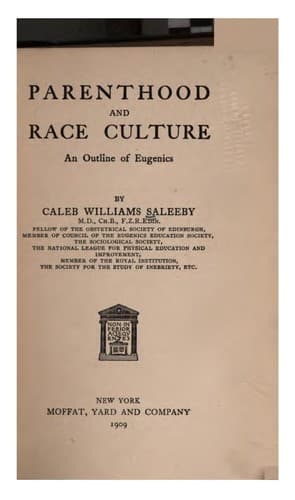
Parenthood and Race Culture: An Outline of EugenicsSaleeby, C. W. (Caleb Williams)
Philosophy
Parenthood and Race Culture: An Outline of Eugenics
Saleeby, C. W. (Caleb Williams)
Eugenics
certainly be dealt with on the lines indicated by our principles.[47]
=Other cases.=--So far we have considered exclusively diseases and
disorders of the brain, the question of alcoholism being deferred to
a special chapter. When we come to other forms of defect or disease
we find a long gradation of instances: at the one extreme being cases
where the fact of disastrous inheritance is palpable and inevitable,
whilst at the other extreme are kinds of disease and defect as to which
the share of heredity is still very uncertain. In some instances, then,
the eugenist is bound to lay down the most emphatic propositions,
as, for instance, that parenthood on the part of men suffering from
certain diseases is and should and must be regarded and treated as a
crime of the most heinous order: whilst in other instances all we can
say is that here is a direction in which more knowledge is needed.
Some particular cases may be referred to.
The diseases known as Daltonism or colour-blindness, and hæmophilia
or the “bleeding disease,” are certainly hereditary. The sufferers
are usually male, but the disease is commonly transmitted by their
daughters (who do not themselves suffer) to their male descendants.
As regards colour-blindness, the defect is evidently insufficient
to concern the eugenist, but hæmophilia is a serious disease, the
transmission of which should not be excused. It may seem hard to assert
that the daughter of a hæmophilic father should not become a mother,
she herself being free from all disease. But it has to be remembered
that the possibility of this hardship depends upon the fact that a
hæmophilic man has become a father, as he should not have done.
This point, as to the amount of hardship involved in the observance
of negative race-culture, has always to be kept in mind. If negative
eugenics were generally enforced upon a given generation some
persons would, of course, suffer in greater or less degree from the
disabilities imposed upon them. But their number would depend upon the
neglect of eugenics by previous generations, and _thereafter the number
of those upon whom our principles pressed hardly would be relatively
minute_.
Public-domain text, read in full here on John Shaqi.
Reviews
Reviews
No reviews yet
Be the first to share your thoughts on this work.
Elsewhere in the archive
Join the Discussion
Join the discussion
Sign in to leave a comment or review.
Sign InorCreate an account