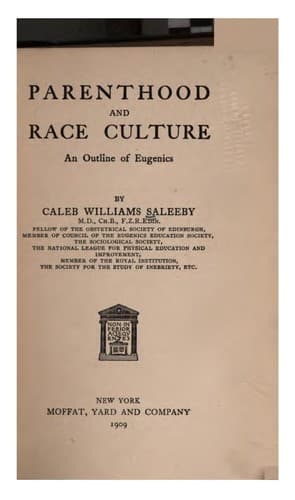
Parenthood and Race Culture: An Outline of EugenicsSaleeby, C. W. (Caleb Williams)
Philosophy
Parenthood and Race Culture: An Outline of Eugenics
Saleeby, C. W. (Caleb Williams)
Eugenics
=Eugenics and tuberculosis.=--It would not be correct to say that
the old view of consumption regarded it as hereditary. In this and a
hundred other matters, medical, astronomical, or what we please, if
we go back to the Arabic students, or further, to the Greeks, we are
lucky enough to find sound observation and reasoning. Many quotations
might be made to show that the infectious nature of tuberculosis was
recognised long ago, just as the revolution of the earth round the
sun was recognised a millennium and a half before Copernicus. But
the view of our more immediate fathers was that tuberculosis is a
hereditary degeneration, and the medical profession proclaimed with no
uncertain sound the hopeless and paralysing doctrine that an almost
certain doom hung over the children of the consumptive. Then, in
memorable succession, came Villemin, Pasteur, and lastly Koch, with
his discovery of the bacillus in 1882. The doctrine was then altered
in its statement. There was, of course, no choice in the matter, since
it was easy to show that not one new-born baby in millions harbours
a tubercle bacillus; so all-but-miraculous and, rightly considered,
beautiful are the ante-natal defences. It was taught, then, that we
inherit a predisposition from consumptive parents, that the bacillus
is ubiquitous, and that variations in susceptibility determine the
incidence of the disease in one and not in another. It was lightly
assumed (simply through what may be called the inertia of belief)
that these variations in susceptibility were hereditary; but we are
wholly without evidence that the hereditary factor counts for anything
substantial, even assuming that it appreciably exists at all. These
differences, so far from being inherent, may be _most palpably_
acquired. Under-feeding, alcohol, and influenza, let us say, will
adequately prepare any human soil. Furthermore, we are learning that
the bacillus is nothing like so ubiquitous as used to be supposed.
Tuberculosis is now sometimes described as a dwelling disease. It might
probably be described with still more accuracy as a bed-room disease,
or a bed-room and public-house disease. It has been evident for many
years past that the more we learnt about tuberculosis the less did
we talk about heredity; and in one of the most recent authoritative
pronouncements[48] upon the subject, the lecturer did not even allude
to heredity at all. Many readers will be up in arms at once with
apparently contrary instances; and much labour may be spent in the
mathematical analysis of statistical data--as that of cases where a
father and a child have tuberculosis. But suppose the father kissed the
child? What have you proved regarding heredity? No mathematics can get
more out of the data than is in them.
Public-domain text, read in full here on John Shaqi.
Reviews
Reviews
No reviews yet
Be the first to share your thoughts on this work.
Elsewhere in the archive
Join the Discussion
Join the discussion
Sign in to leave a comment or review.
Sign InorCreate an account