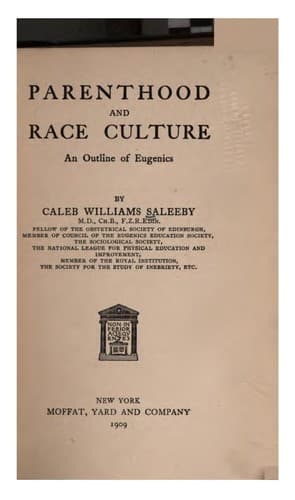
Parenthood and Race Culture: An Outline of EugenicsSaleeby, C. W. (Caleb Williams)
Philosophy
Parenthood and Race Culture: An Outline of Eugenics
Saleeby, C. W. (Caleb Williams)
Eugenics
“For instance, when the suggestion has been made that the law should
step in and prevent unfit individuals from contracting marriage,
the objection has at once been raised that any such measure would
be impracticable. Now we find that many savages have tried the
experiment and succeeded. Mr. Im Thurn tells us that among the wild
Indians of Guiana, a man, before he is allowed to choose a wife, must
prove that he can do a man's work and is able to support himself
and his family. In various Bechuana and Kaffir tribes, according
to Livingstone, a youth is prohibited from marrying until he has
killed a rhinoceros. Among the Dyaks of Borneo no one can marry
until he has in his possession a certain number of human skulls.
Among the Arabs of Upper Egypt a man must undergo an ordeal of
whipping by the relatives of his bride, in order to test his courage;
and if he wishes to be considered worth having, he must receive
the chastisement, which is sometimes exceedingly severe, with an
expression of enjoyment.
“I do not say that these particular methods are worthy of slavish
imitation, but the principle underlying them is certainly excellent,
and especially the fact that they are recognised and enforced by
custom shows that it has been quite possible among many people to
prohibit certain unfit individuals from marrying. The question
naturally arises whether, after all, something of the same kind may
not be possible among ourselves.”
=Mr. Galton's evidence.=--But Mr. Galton himself, with his
characteristic thoroughness, and in full recognition of the fact that
this young science must meet ignorant as well as other objections, read
before the Sociological Society[50] a paper entitled “Restrictions
in Marriage,” with special reference to the objection “that human
nature would never brook interference with the freedom of marriage....
How far have marriage restrictions proved effective, when sanctified
by the religion of the time, by custom and by law? I appeal from
armchair criticism to historical facts.” Mr. Galton then proceeds to
quote seven forms of restriction in marriage which have actually been
practised--monogamy, endogamy, exogamy, Australian marriages, taboo,
prohibited degrees and celibacy. He shows how powerful under each of
these heads is the influence of “immaterial motives” upon marriage
selection, how they may all become hallowed by religion, accepted as
custom and enforced by law. “Persons who are born under their various
rules, live under them without any objection. They are unconscious of
their restrictions as we are unaware of the tension of the atmosphere.”
In many cases the establishment of monogamy and the prohibition
of polygamy “has been due not to any natural instinct against the
practice, but to consideration of social well-being.” “It was penal
for a Greek to marry a barbarian, for a Roman patrician to marry a
plebeian, for a Hindoo of one caste to marry one of another caste,
Public-domain text, read in full here on John Shaqi.
Reviews
Reviews
No reviews yet
Be the first to share your thoughts on this work.
Elsewhere in the archive
Join the Discussion
Join the discussion
Sign in to leave a comment or review.
Sign InorCreate an account