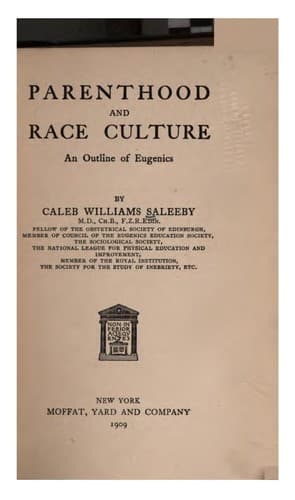
Parenthood and Race Culture: An Outline of EugenicsSaleeby, C. W. (Caleb Williams)
Philosophy
Parenthood and Race Culture: An Outline of Eugenics
Saleeby, C. W. (Caleb Williams)
Eugenics
and so forth. Similar restrictions have been enforced in multitudes
of communities, even under the penalty of death.” Cases from ancient
Jewish law are quoted; and, to take a very different case, that of the
marriage rule amongst the Australian bushmen, it is shown that “the
cogency of this rule is due to custom, religion and law, and is so
strong that nearly all Australians would be horrified at the idea of
breaking it.” Passing further on, one need offer no excuse for quoting,
regarding marriage in general, the following words of the founder of
eugenics:--“_The institution of marriage as now sanctified by religion
and safeguarded by law in the more highly civilised nations, may not
be ideally perfect, nor may it be universally accepted in future
times, but it is the best that has hitherto been devised for the
parties primarily concerned, for their children, for home life, and for
society._”
Mr. Galton then proceeds to show how extensive are the restrictions in
marriage already recognised and practised amongst ourselves and quite
contentedly accepted. He proves also that our objection to marriage
within prohibited degrees depends mainly upon what he calls immaterial
considerations, and adds “it is quite conceivable that a non-eugenic
marriage should hereafter excite no less loathing than that of a
brother and sister would do now.” Then, in allusion to the possibility
“of a whole-hearted acceptance of eugenics as a national religion ...
the thorough conviction by a nation that no worthier object exists
for man than the improvement of his own race,” Mr. Galton shows from
the history of conventual life what abundant evidence there is “of
the power of religious authority in directing and withstanding the
tendencies of human nature towards freedom in marriage.” This paper
was discussed by no less than twenty-six authorities, British and
Continental, and in his reply Mr. Galton observes that not one of them
impugns his main conclusion “that history tells how restrictions in
marriage, even of an excessive kind, have been contentedly accepted
very widely, under the guidance of what I called immaterial motives.”
Lastly, we may note Mr. Galton's admirable distinction between the
two stages of love, “that of slight inclination and that of falling
thoroughly into love, for it is the first of these rather than the
second that I hope the popular feeling of the future will successfully
resist. Every match-making mother appreciates the difference. If a
girl is taught to look upon a class of men as tabooed, whether owing
to rank, creed, connections or other causes, she does not regard them
as possible husbands and turns her thoughts elsewhere. The proverbial
‘Mrs. Grundy’ has enormous influence in checking the marriages she
considers indiscreet.”
Public-domain text, read in full here on John Shaqi.
Reviews
Reviews
No reviews yet
Be the first to share your thoughts on this work.
Elsewhere in the archive
Join the Discussion
Join the discussion
Sign in to leave a comment or review.
Sign InorCreate an account