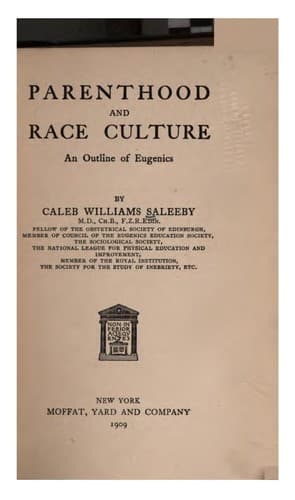
Parenthood and Race Culture: An Outline of EugenicsSaleeby, C. W. (Caleb Williams)
Philosophy
Parenthood and Race Culture: An Outline of Eugenics
Saleeby, C. W. (Caleb Williams)
Eugenics
=Sexual selection is certainly true of mankind.=--Before adducing
the outlines of the evidence in favour of marriage as an instrument
of selection, it may be well to point out that here we are really
discussing what Darwin called “sexual selection,” modified by the
psychology and peculiar characters of mankind. We must protect
ourselves from the critics who will remind us that sexual selection
is very largely discredited to-day, rather more than a generation
after Darwin's enunciation of it in _The Descent of Man_ (1871). The
controversy regarding sexual selection as the producer of feathers
and markings and song, and so forth, amongst the lower animals, is
fortunately quite irrelevant to our present discussion, which is
concerned with mankind. We can afford to note with equanimity the
observation that, in lower species, no mature female goes unmated,
for instance; the fact remains that in the case of mankind a very
considerable percentage of women remain unmarried. The case is similar
as regards the male sex. In short, one may declare that, whether or not
sexual selection is possible, or occurs, or accomplishes anything, in
the case of the lower animals, it palpably and patently is possible,
and does occur, amongst mankind, and especially amongst civilised
peoples, in the form of selection by or for marriage--which, as we have
seen, is in effect selection for parenthood. Let us first note the
statistical evidence regarding marriage-selection of health and energy.
=Spencer on marital longevity.=--We are all aware that married people
live longer, on the average, than unmarried people, the conclusion
being, “of course,” that marriage is good for the health. But some are
taken and others left in this respect, and if, for any conceivable
reason, health is a factor making for selection by marriage, that may
be a real explanation, in whole or in part, of the longer life of
married people. Considering the risks to life involved in motherhood,
the superior longevity of married as compared with unmarried women
would be incomprehensible except on some such assumption. Yet it is
the fact, so imperfect still is the entry of the idea of selection
into the popular and even the expert mind, that the superior longevity
of married people is still constantly asserted to mean that marriage
makes for long life; every year, when the statistics are printed, this
argument may be seen in the newspapers, and I remember encountering it
in the _Encyclopædia Britannica_, to my utter astonishment.
Public-domain text, read in full here on John Shaqi.
Reviews
Reviews
No reviews yet
Be the first to share your thoughts on this work.
Elsewhere in the archive
Join the Discussion
Join the discussion
Sign in to leave a comment or review.
Sign InorCreate an account