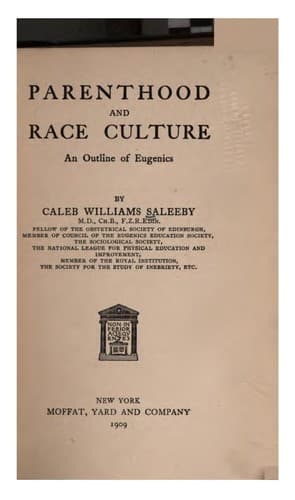
Parenthood and Race Culture: An Outline of EugenicsSaleeby, C. W. (Caleb Williams)
Philosophy
Parenthood and Race Culture: An Outline of Eugenics
Saleeby, C. W. (Caleb Williams)
Eugenics
This uncritical conclusion was disposed of by the author of the phrase
“the survival of the fittest”--appropriately enough--more than thirty
years ago. If the reader will turn to Herbert Spencer's _Study of
Sociology_ (a masterpiece which may be commended to the publishers
for the purpose of indexing--twenty editions without an index are too
many) he will find in Chapter V. a discussion of this question. It is
an astonishing thing that though Spencer conclusively exposed it a
generation ago, the childish fallacy is still apparently as flourishing
as ever. He shows how the greater healthfulness of married life was
supposed to be proved by Dr. Stark from comparison of the rates of
mortality among the married and among the celibate. Then no less an
authority than M. Bertillon went into the matter and contributed a
paper called “The Influence of Marriage”--thus begging the question in
its very title--to the Brussels Academy of Medicine. He showed that,
from twenty-five to thirty years of age, several Continental countries
being taken into the reckoning, “the mortality per thousand is 4 in
married men, 10.4 in bachelors, and 22 in widows. This beneficial
influence of marriage is manifested at all ages, being always more
strongly marked in men than in women.” The absurdity of the apparent
conclusion regarding widows is surely, as Spencer says, too obvious
for discussion. But, for the rest, Spencer goes on to show that,
in reality, “marriage and longevity are concomitant results of the
same cause”--in other words, “that superior quality of organisation
which conduces to long life also conduces to marriage. It is normally
accompanied by a predominance of the instincts and emotions prompting
marriage; there goes along with it that power[51] which can secure the
means of making marriage practicable; and it increases the probability
of success in courtship.” Spencer shows how “of men whose marriages
depend upon getting the needful income,” those who will succeed
are in general “the best, physically and mentally--the strong, the
intellectually capable, the morally well-balanced.” He shows also
how “women are attracted towards men of power--physical, emotional,
intellectual; and obviously their freedom of choice leads them, in many
cases, to refuse inferior samples of men; especially the malformed, the
diseased, and those who are ill-developed, physically and mentally.
So that, in so far as marriage is determined by female selection,
the average result on men is that while the best easily get wives, a
certain proportion of the worst are left without wives.”
Public-domain text, read in full here on John Shaqi.
Reviews
Reviews
No reviews yet
Be the first to share your thoughts on this work.
Elsewhere in the archive
Join the Discussion
Join the discussion
Sign in to leave a comment or review.
Sign InorCreate an account