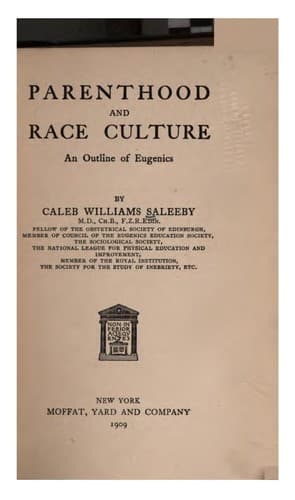
Parenthood and Race Culture: An Outline of EugenicsSaleeby, C. W. (Caleb Williams)
Philosophy
Parenthood and Race Culture: An Outline of Eugenics
Saleeby, C. W. (Caleb Williams)
Eugenics
The controversy between Lamarck and Weismann has _absolutely nothing
to do with the question_. Let us consider what would be a case of
Lamarckian transmission in the sense which the modern student of
heredity denies. The birth of a child with a scar on its scalp, to a
father who had acquired a similar scar before the child was conceived,
would be such a case: and this does not happen. Or suppose that instead
of a scar on the scalp the father has an inflammatory change, not so
dissimilar to a scar, produced by alcohol in the membranes covering
his brain. Then it would be a case of Lamarckian transmission if the
membranes of his baby's brain were similarly affected; and this does
not happen. Such is the kind of transmission of which exhaustive
experiment and observation fail to find a conclusive instance anywhere.
But what has such a supposition to do with the theory, as definitely
supported by observation and experiment as the other is not, that if a
man saturates his body with alcohol carried by his blood, he injures
all the tissues which are nourished by that blood, including the racial
elements of his body with the rest: and therefore that his child may be
degenerate?
What says Weismann himself? In _The Germ-Plasm_, p. 386, under the
heading “The influence of temporary abnormal conditions of the parents
on the child,” he writes as follows:--
“Although I do not consider that the cases which come under the
above heading have anything to do with heredity, I should not like to
leave them entirely on one side.
“It has often been supposed that drunkenness of the parents at the
time of conception may have a harmful effect on the nature of the
offspring. The child is said to be born in a weak bodily and mental
condition, and inclined to idiocy, or even to madness, etc., although
the parents may be quite normal both physically and mentally.
“Cases certainly exist in which drunken parents have given rise to
a completely normal child, although this is not a convincing proof
against the above-named view; and in spite of the fact that most, or
perhaps even all, the statements with regard to the injurious effects
on the offspring will not bear a very close criticism,[58] I am
unwilling to entirely deny the _possibility_ that a harmful influence
may be exerted in such cases. These, however, have nothing to do with
heredity, but are concerned with an _affection of the germ by means
of an external influence_.”
Weismann goes on to quote cases showing how germ-cells may be injured
by various agents, and continues:--
“It does not appear to me impossible that an intermixture of alcohol
with the blood of the parents may produce similar effects on the ovum
and sperm cell. According to the relative quantity of alcohol either
an exciting or a depressing influence might be exerted, either of
which would lead to abnormal development....
Public-domain text, read in full here on John Shaqi.
Reviews
Reviews
No reviews yet
Be the first to share your thoughts on this work.
Elsewhere in the archive
Join the Discussion
Join the discussion
Sign in to leave a comment or review.
Sign InorCreate an account