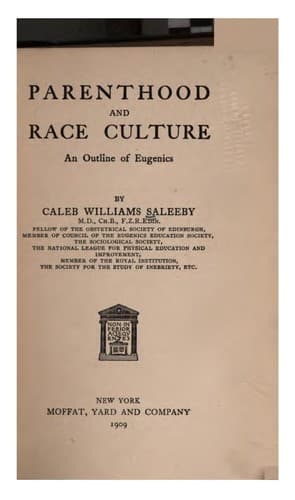
Parenthood and Race Culture: An Outline of EugenicsSaleeby, C. W. (Caleb Williams)
Philosophy
Parenthood and Race Culture: An Outline of Eugenics
Saleeby, C. W. (Caleb Williams)
Eugenics
“_New_ predispositions can certainly never arise owing to such
deviations from the normal course of development, and therefore
a modification of the process of heredity itself is out of the
question. It is, however, conceivable that more or less considerable
abnormalities may affect the course of development, and either
cause the death of the embryo, or else produce more or less marked
deformities. The question as to whether such deformities really
result in consequence of the drunken condition of the parents can
only be decided by observation.”[59]
This is all that Weismann has to say on the subject, since, not
referring to functionally-produced modifications,[60] it does not
concern his theory of heredity at all: yet it is upon this theory that
the most palpable facts of the racial influence of alcohol are denied.
Weismann's own remarks are quite open to criticism, as, for instance,
where he denies that new predispositions can arise in the manner
indicated. This is possibly only a question of words, and Weismann is
perhaps merely denying that alcohol can produce progressive variations.
Also his remarkably brief discussion of the subject seems to concern
itself mainly with the influence of alcohol on the germ-cells _just
before their union_. He has not a word to say regarding the influence
on the germinal tissues of years of soaking in alcohol. It suffices,
however, to make the point which is quite clearly made, that the
Weismannians are going absurdly beyond their book in denying what,
indeed, the book of Nature demonstrates.
Let us turn now to the experimental side of this question. An American
botanist, Dr. T. D. MacDougal, read an address on “Heredity and
Environic Forces” at the Chicago Meeting of the American Association
for the Advancement of Science in 1907. His experiments require
confirmation, but may be provisionally accepted. He has permanently
modified the germ-plasm of plants under the influence of various
chemicals. There is here a vast field for experiment with alcohol.
I quote one paragraph indicating the remarkable results of these
experiments. The reader will see their bearing on our present question,
and will also see that they do not for a moment affect Weismann's
denial of the doctrine that by cutting off rats' tails you can produce
a race of tailless rats, or that by learning a language you can save
your future children the trouble of doing so for themselves:--
Public-domain text, read in full here on John Shaqi.
Reviews
Reviews
No reviews yet
Be the first to share your thoughts on this work.
Elsewhere in the archive
Join the Discussion
Join the discussion
Sign in to leave a comment or review.
Sign InorCreate an account