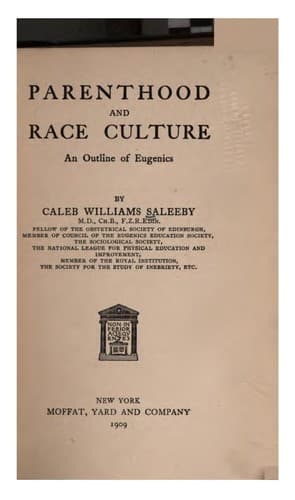
Parenthood and Race Culture: An Outline of EugenicsSaleeby, C. W. (Caleb Williams)
Philosophy
Parenthood and Race Culture: An Outline of Eugenics
Saleeby, C. W. (Caleb Williams)
Eugenics
NATIONAL EUGENICS: RACE-CULTURE AND HISTORY[76]
The reader will not expect to be insulted here with any discussion of
the garbage and gossip, records of scoundrels, courts and courtesans,
battles, murder and theft, which we were taught at school, under the
great name of history.[77] If history be, as nearly all historians have
conceived it, and as Gibbon defined it, “little more than the register
of the crimes, follies, and misfortunes of mankind,” it is an empty and
contemptible study, save for the social pathologist. But if history,
without by any means ignoring great men or underrating their influence,
is, or should be, the record of the past life of mankind, of progress
and decadence, the rise and fall of Empires and civilisations, and
their mutual reactions; if it be the record of the intermittent ascent
of man, “sagging but pertinacious”; if this record be subject to the
law of causation, and therefore susceptible, in theory, at least, of
explanation as well as description; if its factors are at work to-day
and will shape the destiny of all the to-morrows; if it be neither
phantasmagoria nor panorama nor pageant nor procession but _process_,
in short, an organic drama,--then, indeed, it is more than worthy
of all the study and thought of all who ever study or ever think.
Especially must it appeal to us, who boast a tradition greater than the
world has ever yet seen, and kinship with men who represent the utmost
of which the human spirit has yet shown itself capable,--to us who
speak the tongue that Shakespeare spake, but to whom the names of all
our Imperial predecessors, from Babylon to Spain, serve as a perpetual
_memento mori_. Our special question here is whether there are inherent
and necessary reasons why our predecessors' fate must sooner or later
be ours. Must races die?--or, if we are sceptical about races and more
especially about the so-called Anglo-Saxon race, must civilisations,
states, or nations die? What comment does modern biology, or the theory
of organic evolution, make upon the familiar words of Byron in his
address to the ocean?--
“Thy shores are empires, changed in all save thee--
Assyria, Greece, Rome, Carthage, what are they?
Thy waters wasted them while they were free
And many a tyrant since: their shores obey
The stranger, slave, or savage.”
And these, a few pages earlier in the same poem:--
“There is the moral of all human tales;
'Tis but the same rehearsal of the past,
First Freedom and then Glory--when that fails,
Wealth, vice, corruption--barbarism at last.
And History, with all her volumes vast,
Hath but _one_ page”....
Public-domain text, read in full here on John Shaqi.
Reviews
Reviews
No reviews yet
Be the first to share your thoughts on this work.
Elsewhere in the archive
Join the Discussion
Join the discussion
Sign in to leave a comment or review.
Sign InorCreate an account