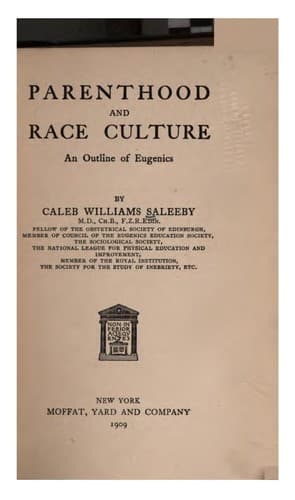
Parenthood and Race Culture: An Outline of EugenicsSaleeby, C. W. (Caleb Williams)
Philosophy
Parenthood and Race Culture: An Outline of Eugenics
Saleeby, C. W. (Caleb Williams)
Eugenics
Nations, races, civilisations rise, we shall all agree, because to
inherent virtue of breed they add sound customs and laws, acquirements
of discipline and knowledge. But, these acquirements made, power
established, and crescent from year to year--why do they _then_ fall?
If they can _make_ a place for themselves, how much easier should it
not be to _maintain_ it?
Two explanations, each falsely asserting itself to be rooted in
biological fact, have long been cited and are still cited in order to
account for these supreme tragedies of history.
=The fallacy of racial senility.=--The first may claim Plato and
Aristotle as its founders, and consists of an argument from analogy.
Races may be conceived in similar terms to individuals. There are many
resemblances between a society--a “social organism,” to use Herbert
Spencer's phrase--and an individual organism. Just, then, as the
individual is mortal, so is the race. Each has its birth, its period of
youth and growth, its maturity, and, finally, its decadence, senility
and death. So runs the common argument.
We must reply, however, that biology, so far from confirming it,
declares as the capital fact which contrasts the individual and the
race that, whilst the individual is doomed to die from inherent causes,
the race is naturally immortal. The tendency of life is not to die but
to live. If individuals die, that is doubtless because, as I believe,
more life and fuller is thus attained than if life bodied itself in
immortal forms: but the germ-plasm is immortal; it has no inherent
tendency either to degenerate or to die. Species exist and flourish
now which are millions of years older than mankind. “The individual
withers, the race is more and more.”
Public-domain text, read in full here on John Shaqi.
Reviews
Reviews
No reviews yet
Be the first to share your thoughts on this work.
Elsewhere in the archive
Join the Discussion
Join the discussion
Sign in to leave a comment or review.
Sign InorCreate an account