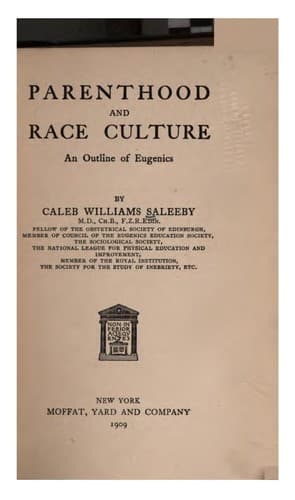
Parenthood and Race Culture: An Outline of EugenicsSaleeby, C. W. (Caleb Williams)
Philosophy
Parenthood and Race Culture: An Outline of Eugenics
Saleeby, C. W. (Caleb Williams)
Eugenics
NATIONAL EUGENICS: MR. BALFOUR ON DECADENCE
(1) “If the various checks specified in the two last paragraphs,
and perhaps others as yet unknown, do not prevent the reckless, the
vicious, and otherwise inferior members of society from increasing
at a quicker rate than the better class of men, the nation will
retrograde, as has too often occurred in the history of the world.
We must remember that progress is no invariable rule. It is very
difficult to say why one civilised nation rises, becomes more
powerful, and spreads more widely, than another; or why the same
nation progresses more quickly at one time than at another. We can
only say that it depends on an increase in the actual number of the
population, on the number of the men endowed with high intellectual
and moral faculties, as well as on their standard of excellence.
Corporeal structure appears to have little influence, except so far
as vigour of body leads to vigour of mind.”--Darwin, _The Descent of
Man_, 1871.
(2) Referring to “the rates with which the various classes of
society (classified according to civic usefulness) have contributed
to the population at various times, in ancient and modern nations,”
Mr. Francis Galton said “there is strong reason for believing
that national rise and decline is closely connected with this
influence.”--Galton, _Sociological Papers_, 1904, p. 47.
(3) “The inexplicable decline and fall of nations following from no
apparent external cause receives instant light from the relative
fertility of the fitter and unfitter elements combined with what we
now know of the laws of inheritance.”[82]--Pearson, 1904.
(4) To the question, What were the causes of the fall of
Rome? Mr. Balfour replies, “I feel disposed to answer,
Decadence.”[83]--Balfour, 1908.
The lecture of which the previous chapter is the written form was
prepared and delivered before I had an opportunity of seeing Mr. A. J.
Balfour's lecture on “Decadence” delivered a few days before. That has
since been printed, and is well worthy of our attention. In Mr. Balfour
we have a representative political thinker, an experimental statesman
and, furthermore, a former President of the British Association, deeply
interested in, and favourably disposed towards, scientific enquiry and
the scientific method. Further, this lecture has been widely noticed,
though all the criticisms I have seen seem to me to miss the point.
No apology, then, is necessary for a special discussion of this most
suggestive lecture in direct relation with the foregoing theory of its
subject.
Public-domain text, read in full here on John Shaqi.
Reviews
Reviews
No reviews yet
Be the first to share your thoughts on this work.
Elsewhere in the archive
Join the Discussion
Join the discussion
Sign in to leave a comment or review.
Sign InorCreate an account