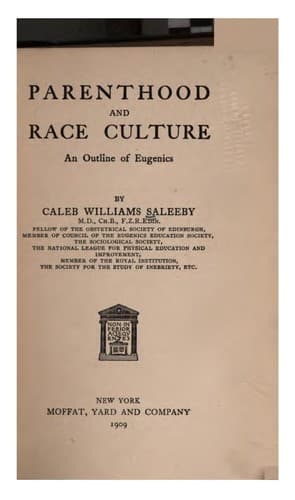
Parenthood and Race Culture: An Outline of EugenicsSaleeby, C. W. (Caleb Williams)
Philosophy
Parenthood and Race Culture: An Outline of Eugenics
Saleeby, C. W. (Caleb Williams)
Eugenics
Political and national decadence is Mr. Balfour's theme, and we note
first that here is a contemporary thinker, not unread in recent
biology, including the work of Weismann, who is prepared to make use
of the idea that societies are inherently mortal, as individuals are.
One wonders when we shall be rid of this pernicious instance of the
argument from analogy, which is already much more than two thousand
years old.
Next it may be noticed that, though Mr. Balfour has deliberately
discussed the idea of natural selection, he has been led wholly
astray from its true relation to the question under discussion by
reason of falling into the common error which Sir E. Ray Lankester
has recently exposed, as Huxley did several decades ago. Mr. Balfour
conceives natural selection to issue from the struggle for existence
between species or societies. It has already been pointed out that the
all-important natural selection is not between species or societies
but within them. The struggle for existence is fought out mainly
between the immature individuals of any species or society. Its issue
determines the survivors for parenthood and the future. Mr. Balfour
must have read Professor Ray Lankester's recent Romanes Lecture in
which all this is so clearly shown, but he has unfortunately retained
the popular conception of natural selection as acting between species
or societies, and has in consequence failed, I will not say to find,
but even to discuss in any adequate measure, the theory of racial
and national decadence, defined in the preceding chapter. He merely
discusses “competition between groups of communities,” and rightly
finds it inadequate to account for the great tragedies of history.
There follows a passage which may be heartily assented to, on the very
grounds on which the entire lecture may be welcomed, namely, that
it suggests the inadequacy of the common explanations of national
decadence advanced by historians. Says Mr. Balfour:--
“It is in vain that historians enumerate the public calamities which
preceded, and no doubt contributed to, the final catastrophe. Civil
dissensions, military disasters, pestilences, famines, tyrants,
tax-gatherers, growing burdens, and waning wealth--the gloomy
catalogue is unrolled before our eyes, yet somehow it does not in all
cases wholly satisfy us: we feel that some of these diseases are of a
kind which a vigorous body politic should easily be able to survive,
that others are secondary symptoms of some obscurer malady, and that
in neither case do they supply us with the full explanation of which
we are in search.”
Public-domain text, read in full here on John Shaqi.
Reviews
Reviews
No reviews yet
Be the first to share your thoughts on this work.
Elsewhere in the archive
Join the Discussion
Join the discussion
Sign in to leave a comment or review.
Sign InorCreate an account