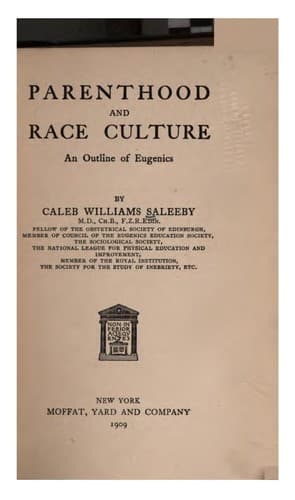
Parenthood and Race Culture: An Outline of EugenicsSaleeby, C. W. (Caleb Williams)
Philosophy
Parenthood and Race Culture: An Outline of Eugenics
Saleeby, C. W. (Caleb Williams)
Eugenics
Nowhere in this lecture is there any recognition of what, I confess,
seems to me to be an obvious and necessary truth, the distinction
between the two kinds of progress--racial progress due to the choice
of the best for parenthood, and acquired or traditional progress. It
may be suggested that no one can usefully discuss decadence or progress
until he has seen and perceived this absolutely cardinal distinction,
suggested in my Royal Institution lectures in February, 1907, as one
of the great lessons taught by the study of biology to the student of
progress.
Mr. Balfour does indeed avoid all those false solutions which depend
upon a Lamarckian belief in the transmission of acquired characters.
This, however, instead of leading him to insist upon the Darwinian
contribution to the study of decadence--the idea of _selection_--causes
him to regard the racial question as unimportant. He notes one or
two of the fashions in which the quality of a race may be modified,
thus influencing national character, and then dismisses this question
(wherein, as I cannot doubt, everything material lies) with the remark,
“But such changes are not likely, I suppose, to be considerable,
except perhaps those due to the mixture of races--and that only in new
countries.”--Reaching page 45, the reader finds himself confident that
now at length the writer has put his finger on the crux of the problem.
Yet that is how he dismisses it; adding, indeed, to make it quite
clear, the following words: “The flexible element in any society, that
which is susceptible of progress or decadence, must therefore be looked
for rather in the physical and psychical conditions affecting the life
of its component units, than in their inherited constitution.”
Not a word as to cessation of selection! This omission, which is,
indeed, the omission of _the_ fact of decadence, mainly depends, one
fancies, upon that erroneous conception of natural selection as acting
between species and societies rather than within them, which for so
many decades the biologist has been at pains to correct. One would
indeed have thought that, for a scholar and student like Mr. Balfour,
Wordsworth's great sonnet would have sufficed to set up a train of
thought which, fusing with ordinary biological principles, would have
led him to what I believe to be the truth. Let us for a moment turn to
its consideration:--
“When I have borne in memory what has tamed
Great Nations, how ennobling thoughts depart
When men change swords for ledgers....”
Public-domain text, read in full here on John Shaqi.
Reviews
Reviews
No reviews yet
Be the first to share your thoughts on this work.
Elsewhere in the archive
Join the Discussion
Join the discussion
Sign in to leave a comment or review.
Sign InorCreate an account