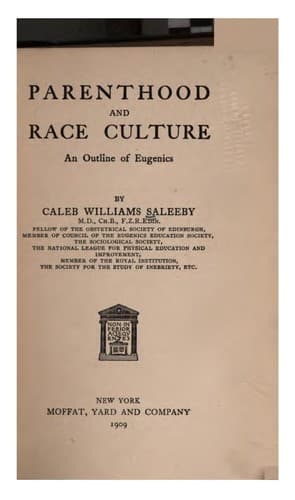
Parenthood and Race Culture: An Outline of EugenicsSaleeby, C. W. (Caleb Williams)
Philosophy
Parenthood and Race Culture: An Outline of Eugenics
Saleeby, C. W. (Caleb Williams)
Eugenics
One must heartily thank the author for the abundant demonstration
which follows, well warranting our feeling that these explanations do
not suffice--nor yet, in the case of Rome, diminution of population,
nor the “brutalities of the gladiatorial shows,” nor “the gratuitous
distribution of bread to the urban mobs,” nor yet slavery, lately
declared, by Mr. W. R. Paterson, in his _Nemesis of Nations_, to be
_the_ cause of the fall of empires. As Mr. Balfour says, “Who can
believe that this immemorial custom could, in its decline, destroy
the civilisation which, in its vigour, it had helped to create?” It
would have been more important, perhaps, to consider, as Mr. Balfour
does not, the latest view, advanced by Professor Ronald Ross, that the
incursion of malaria may have had something to do with the fall of Rome.
=Mr. Balfour's theory--decadence the cause of decadence.=--Mr. Balfour
then falls back upon “decadence "as the explanation, and to the
critic of this elegant hypothesis that decadence is due to decadence,
replies that it is something to recognise the possibility of "subtle
changes in the social tissues of old communities.” One regrets all
the more that he should not have considered anti-eugenic practices
as possibly accounting for these subtle changes. One must, however,
quote the excellent passage in which Mr. Balfour supports his use of
the word decadence, though one utterly disagrees with the suggestion
that the term “old age” might be its equivalent. He says: “The facile
generalisations with which we so often season the study of dry historic
fact; the habits of political discussion which induce us to catalogue
for purposes of debate the outward signs that distinguish (as we are
prone to think) the standing from the falling state, hide the obscurer,
but more potent, forces which silently prepare the fate of empires.”
We may note with interest (and surely with surprise when we consider
Japan and Spain and the China of to-morrow), Mr. Balfour's rejection
of the doctrine that “arrested progress, and even decadence, may be
but the prelude to a new period of vigorous growth. So that even those
races or nations which seem frozen into eternal immobility may base
upon experience their hopes of an awakening spring.” It is, I fancy,
Mr. Balfour's fondness for the Platonic idea of senility in the race
as in the individual, that leads him to question what can surely
be no longer denied. Thus a little later we find him saying, “_If
civilisations wear out, and races become effete_, why should we expect
to progress indefinitely, why for us alone is the doom of man to be
reversed?”
Public-domain text, read in full here on John Shaqi.
Reviews
Reviews
No reviews yet
Be the first to share your thoughts on this work.
Elsewhere in the archive
Join the Discussion
Join the discussion
Sign in to leave a comment or review.
Sign InorCreate an account