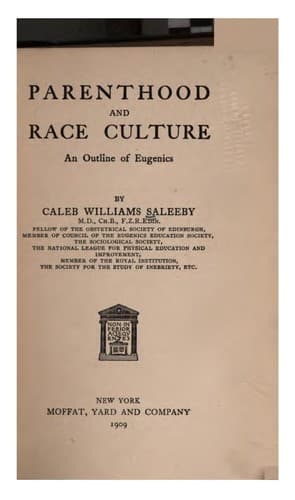
Parenthood and Race Culture: An Outline of EugenicsSaleeby, C. W. (Caleb Williams)
Philosophy
Parenthood and Race Culture: An Outline of Eugenics
Saleeby, C. W. (Caleb Williams)
Eugenics
Having rejected so many solutions of his problem, and having ignored
the solution which is advanced in this volume, Mr. Balfour is reduced
to such desperate resorts as phrases like this: “The point at which
the energy of advance is exhausted”--a mere meaningless phrase; and
even such an explanation as that through “mere weariness of spirit the
community resigns itself to ... stagnation.” One is inclined to throw
up one's hands and ask--Do you, then, who deny the Lamarckian theory,
suppose that the fresh children come into the world with this “mere
weariness of spirit”? Has this been observed in children? Is there
anything conceivable that has been less observed in children, in all
times and all places? And if that be so, what kind of explanation of
decadence is this?
=Science and industry.=--Lastly, in a series of fine passages, Mr.
Balfour offers us some hope in the help of science. Politics, says our
ex-Premier, too often means “the barren exchange of one set of tyrants
or jobbers, for another”: a Daniel come to judgment. We owe the modern
spirit and modern progress, he tells us, neither to politicians nor to
political institutions, nor to theologians nor to philosophers, but
to science, which, he well says, “is the great instrument of social
change, all the greater because its object is not change but knowledge;
and its silent appropriation of this dominant function, amid the
din of political and religious strife, is the most vital of all the
revolutions which have marked the development of modern civilisation.”
And our cause of hope is “a social force, new in magnitude if not in
kind ... the modern alliance between pure science and industry.” To
this I answer a thousand times yes, but I must define the kind of
industry. It is the culture of the racial life which is the vital
industry of any nation, and which Mr. Balfour has not even distantly
alluded to. I agree that our hope for the future is to be found in
science: that, as has been said already, perchance our acquired or
traditional progress in knowledge has now reached the point at which we
have sufficient to reveal to us the necessity of racial progress and
the means by which that may be effected.
“Science and industry,”--yes, indeed! But the industry is to be the
making not of machines but men. _The products of progress are not
mechanisms but men_, and one may now ask, What is the industry whose
products can be named in the same breath with the men and women who
shall yet be produced by the supreme industry of race-culture?
CHAPTER XVII
THE PROMISE OF RACE-CULTURE
“The best is yet to be.”
Public-domain text, read in full here on John Shaqi.
Reviews
Reviews
No reviews yet
Be the first to share your thoughts on this work.
Elsewhere in the archive
Join the Discussion
Join the discussion
Sign in to leave a comment or review.
Sign InorCreate an account