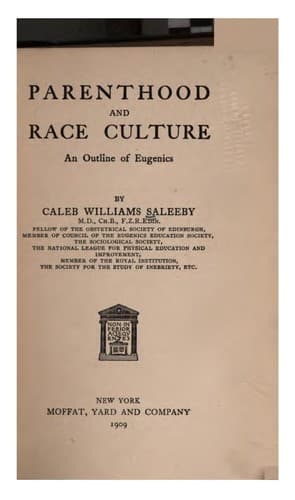
Parenthood and Race Culture: An Outline of EugenicsSaleeby, C. W. (Caleb Williams)
Philosophy
Parenthood and Race Culture: An Outline of Eugenics
Saleeby, C. W. (Caleb Williams)
Eugenics
In its form of what we have called _negative_ eugenics, the practice
of our principle would assuredly reduce to an incalculable extent the
amount of human defect, mental and physical, which each generation
now exhibits. This alone, as has been said, would be far more than
sufficient to justify us. A world without hereditary disease of mind
and body, and its grave social consequences, would alone warrant the
hint of Ruskin that posterity may some day look back upon us with
“incredulous disdain.” Yet, assuming that this could be accomplished,
as it will be accomplished, what more is to be hoped for? Must
race-culture cease merely when it has raised the average of the
community by reducing to a minimum the proportion of those who are
thus grossly defective in mind or body? Such disease apart, are we to
be content, must we be content, with the present level of mediocrity
in respect of intelligence and temper and moral sentiment? Can we
anticipate a London in which the present ratio of musical comedy
to great opera will be reversed, in which the works of Mr. George
Meredith will sell in hundreds of thousands, whilst some of our popular
novelists will have to find other means of earning a living? Can we
make for a critical democracy which no political party can fool, and
which will choose its best to govern it? Yet more, can we undertake,
now or hereafter, to provide every generation with its own Shakespeare
and Beethoven and Tintoretto and Newton? What, in a word, is the
promise of _positive_ eugenics? It is to this aspect of the question
that Mr. Galton has mainly directed himself. Indeed he was led to
formulate the principles and ideals of the new science by his study of
hereditary genius some four decades ago. Let us now attempt to answer
some of these questions.
=The production of genius.=--And first as to the production of genius.
It is this, perhaps, that has been the main butt of the jesters who
pass for philosophers with some of us to-day. It may be said at once
that neither Mr. Galton nor any other responsible person has ever
asserted that we can produce genius at will. The difficulties in the
way of such a project--at present--are almost innumerable. One or two
may be cited.
In the first place, there is the cardinal--but by no means
universal--difficulty that the genius is too commonly so occupied with
the development and expansion of his own individuality that he has
little time or energy for the purposes of the race. This, of course, is
an example of Spencer's great generalisation as to the antagonism or
inverse ratio between individuation and genesis.
Public-domain text, read in full here on John Shaqi.
Reviews
Reviews
No reviews yet
Be the first to share your thoughts on this work.
Elsewhere in the archive
Join the Discussion
Join the discussion
Sign in to leave a comment or review.
Sign InorCreate an account