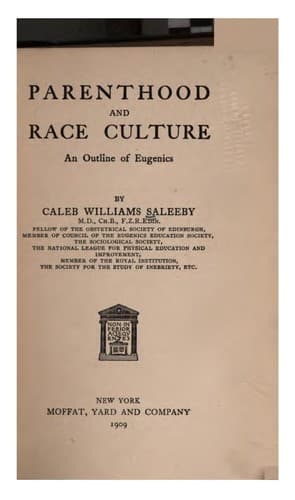
Parenthood and Race Culture: An Outline of EugenicsSaleeby, C. W. (Caleb Williams)
Philosophy
Parenthood and Race Culture: An Outline of Eugenics
Saleeby, C. W. (Caleb Williams)
Eugenics
Again, there is the generalisation of heredity formulated by Mr.
Galton, and named by him the _law of regression towards mediocrity_.
It asserts that the children of those who are above or below the mean
of a race, tend to return towards that mean. The children of the born
criminal will be probably somewhat less criminal in tendency than he,
though more criminal than the average citizen. The children of the
man of genius, if he has any, will probably be nearer mediocrity than
he, though on the average possessing greater talent than the average
citizen. It is thus not in the nature of sheer genius to reproduce
on its own level. It is only the critics who are wholly ignorant of
the elementary facts of heredity that attribute to the eugenist an
expectation of which no one knows the absurdity so well as he does.
On the other hand, it is impossible to question that the hereditary
transmission of genius or great talent does occur. One may cite at
random such cases as that of the Bach family, Thomas and Matthew
Arnold, James and John Stuart Mill: and the reader who is inclined
to believe that there is no law or likelihood in this matter, must
certainly make himself acquainted with Mr. Galton's _Hereditary
Genius_, and with such a paper as that which he printed in
_Sociological Papers_, 1904, furnishing an “index to achievements of
near kinsfolk of some of the Fellows of the Royal Society.” There is,
of course, the obvious fallacy involved in the possibility that not
heredity but environment was really responsible for many of these
cases. It must have been a great thing to have such a father as James
Mill. But it would be equally idle to imagine that the evidence can
be dismissed with this criticism. A Matthew Arnold, a John Stuart
Mill, could not be manufactured out of any chance material by an ideal
education continued for a thousand years.
Public-domain text, read in full here on John Shaqi.
Reviews
Reviews
No reviews yet
Be the first to share your thoughts on this work.
Elsewhere in the archive
Join the Discussion
Join the discussion
Sign in to leave a comment or review.
Sign InorCreate an account