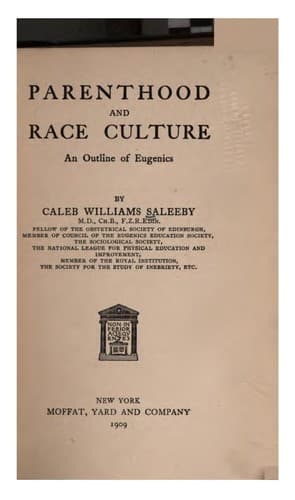
Parenthood and Race Culture: An Outline of EugenicsSaleeby, C. W. (Caleb Williams)
Philosophy
Parenthood and Race Culture: An Outline of Eugenics
Saleeby, C. W. (Caleb Williams)
Eugenics
“It is consistent with all the robust virtues, and makes a large
practice of them possible. It is the measure of fulness of life; the
more energy the more abundance of it; no energy at all is death;
idiots are feeble and listless. In the enquiries I made on the
antecedents of men of science no points came out more strongly than
that the leaders of scientific thought were generally gifted with
remarkable energy, and that they had inherited the gift of it from
their parents and grandparents. I have since found the same to be
the case in other careers.... It may be objected that if the race
were too healthy and energetic there would be insufficient call
for the exercise of the pitying and self-denying virtues, and the
character of men would grow harder in consequence. But it does not
seem reasonable to preserve sickly breeds for the sole purpose of
tending them, as the breed of foxes is preserved solely for sport
and its attendant advantages. There is little fear that misery will
ever cease from the land, or that the compassionate will fail to
find objects for their compassion; but at present the supply vastly
exceeds the demand: the land is over-stocked and over-burdened with
the listless and the incapable. In any scheme of eugenics, energy is
the most important quality to favour; it is, as we have seen, the
basis of living action, and it is eminently transmissible by descent.”
Need it be pointed out that any political system which ceases to favour
or actively disfavours energy, making it as profitable to be lazy as to
be active, is anti-eugenic, and must inevitably lead to disaster? That,
however, by the way. Our present point is that eugenics can reasonably
promise, when its principles are recognised, to multiply the human[84]
and diminish the vegetable type in the community. In so doing, it
will greatly further the production of talent, and therefore of that
traditional or acquired progress which men of talent and genius create.
Such a result will also further, though indirectly, the production
of genius itself. For, as Mr. Galton points out, “men of an order of
ability which is now very rare, would become more frequent, because the
level out of which they rose would itself have risen.”
This is by no means the only fashion in which an effective and
practicable race-culture would serve genius, and I shall not be blamed
for considering this matter further by any reader who realises, however
faintly, what the man of genius is worth to the world. If it were shown
possible to establish such social conditions that genius could never
flower in them, we should realise that their establishment would mean
the putting of an end to progress and the blasting of all the highest
hopes of the highest of all ages.
Public-domain text, read in full here on John Shaqi.
Reviews
Reviews
No reviews yet
Be the first to share your thoughts on this work.
Elsewhere in the archive
Join the Discussion
Join the discussion
Sign in to leave a comment or review.
Sign InorCreate an account