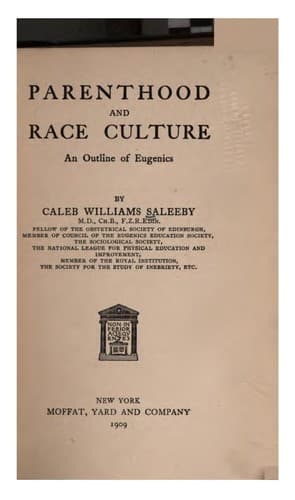
Parenthood and Race Culture: An Outline of EugenicsSaleeby, C. W. (Caleb Williams)
Philosophy
Parenthood and Race Culture: An Outline of Eugenics
Saleeby, C. W. (Caleb Williams)
Eugenics
The immediate need of this age, as of all ages, is perhaps not so much
the birth of babies capable of developing into men and women of genius,
as the full exploitation of the possibilities of genius with which,
as I fancy, every generation on the average is about as well endowed
as any other. There is, of course, the popular doctrine that there are
no mute inglorious Miltons, that “genius will out,” and that therefore
if it does not appear, it is not there to appear. In expressing the
compelling power of genius in many cases, this doctrine is not without
truth. Yet history abounds in instances where genius has been destroyed
by environment--and we can only guess how many more instances there
are of which history has no record. To take the single case of musical
genius, it is a lamentable thought that there may be those now living
whose natural endowments, in a favourable environment, would have
enabled them to write symphonies fit to place beside Beethoven's, but
whom some environmental factors--conventional, economic, educational,
or what not--have silenced; or worse, have persuaded to write such
sterile nullities as need not here be instanced. There is surely no
waste in all this wasteful world so lamentable as this waste of genius.
If, then, anyone could devise for us a means by which the genius,
potentially existing at any time, were realised, he would have
performed in effect a service equivalent to that of which eugenics
repudiates the present possibility--the actual creation of genius. But
if we consider what the conditions are which cause the waste of genius,
we realise at once that they mainly inhere in the level of the human
environment of the priceless potentiality in question. As we noted
elsewhere, in an age like that of Pericles genius springs up on all
hands. It is encouraged and welcomed because the average level of the
human environment in which it finds itself is so high. But if eugenics
can raise the average level of intelligence, in so doing not merely
does it render more likely, as Mr. Galton points out, the production
of men of the highest ability, but it provides those conditions in
which men of genius, now swamped, can swim. We could not undertake
to produce a Shakespeare, but we might reasonably hope to produce a
generation which would not damage or destroy its Shakespeares. And even
if men of genius still found it necessary, as men of genius have found
it necessary, to “play to the gallery,” they would play, as Mr. Galton
says of the demagogue in a eugenic age, “to a more sensible gallery
than at present.”
Darwin somewhere points out that it is not the scientific, but the
unscientific man who denies future possibilities. Thus though an
advocate of eugenics may be applauded for his judgment if he declares
that the creation of genius will for ever be impossible, yet I should
not care to assert that the ultimate limitations of eugenics can thus
be defined. We have yet to hear the last of Mendelism.
Public-domain text, read in full here on John Shaqi.
Reviews
Reviews
No reviews yet
Be the first to share your thoughts on this work.
Elsewhere in the archive
Join the Discussion
Join the discussion
Sign in to leave a comment or review.
Sign InorCreate an account