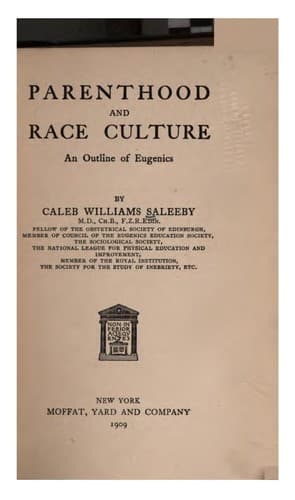
Parenthood and Race Culture: An Outline of EugenicsSaleeby, C. W. (Caleb Williams)
Philosophy
Parenthood and Race Culture: An Outline of Eugenics
Saleeby, C. W. (Caleb Williams)
Eugenics
But even grant, for the sake of the argument, that the intelligence of
a Newton, the musical faculty of a Bach, the moral nature of any good
mother anywhere, represent the utmost limits of which the evolution
of the psychical is capable. There is every reason to deny this, but
let us for the moment assume it true. There still remains the thought
of Wordsworth, “What one is, why may not millions be?”--a thought to
which Spencer has also given utterance. What is shown possible for
human nature here and there, he says, is conceivable for human nature
at large. It is possible for a human being, whilst still remaining
human, to be a Shakespeare or a St. Francis: these things are thus
demonstrably within the possibilities of human nature. It is therefore
at the least conceivable that, in the course of almost infinite time
(even assuming, say, that intelligence must ever be limited, as even
Newton's intelligence was limited), some such capacities as his may be
common property amongst men of the scientific type; and so with other
types. We may answer Wordsworth that there is no bar thrown by Nature
in the way of such a hope.
=What is possible?=--This, of course, is speculation and of no
immediate value. I would merely remind the reader that the doctrine of
optimism, as regards the future of mankind, which the principles of
race-culture assume and which they desire to justify, was definitely
shared by the great pioneers to whom we owe our understanding of those
principles. Notwithstanding grave nervous disorder, such as makes
pessimists of most men, both Darwin and Spencer were compelled by their
study of Nature to this rational optimism as regards man's future.
The doctrine of organic evolution, and of the age-long ascent of man
through the selection of the fittest (who have, _on the whole_, been
the _best_) for parenthood, is one not of despair but of hope. Exactly
half a century ago it struck horror into the minds of our predecessors.
Man, then, is only an erected ape, they thought--as if any historical
doctrine, however true, could shorten the dizzy distance to which man
has climbed since he was simian: and man being an ape, they thought
his high dreams palpably vain. But the measure of the accomplished
hints at the measure of the possible, and the value of the historical
facts lies not in themselves, all facts as such being as dead as are
the individual atoms of the living body, but in the principles which
grow out of them. It is of no importance as such that man has simian
ancestors; it is of immeasurable importance that he should learn by
what processes he has become human, and by what, indeed, they became
simian--which would have been a proud adjective for its own day. The
principles of organic progress matter for us because they are the
principles of race-culture, the only sure means of human progress. Our
looking backwards does not turn us into pillars of salt, but teaches us
that the best is yet to be, and how alone it is to be attained.
Public-domain text, read in full here on John Shaqi.
Reviews
Reviews
No reviews yet
Be the first to share your thoughts on this work.
Elsewhere in the archive
Join the Discussion
Join the discussion
Sign in to leave a comment or review.
Sign InorCreate an account