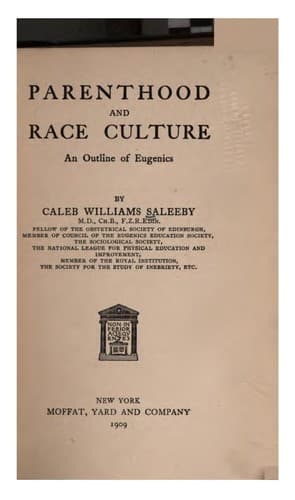
Parenthood and Race Culture: An Outline of EugenicsSaleeby, C. W. (Caleb Williams)
Philosophy
Parenthood and Race Culture: An Outline of Eugenics
Saleeby, C. W. (Caleb Williams)
Eugenics
Elsewhere the optimistic argument of Wordsworth is quoted. Hear also
John Ruskin:--
“There is as yet no ascertained limit to the nobleness of person and
mind which the human creature may attain, by persevering observance
of the laws of God respecting its birth and training.”[85]
and Herbert Spencer:--
“What now characterises the exceptionally high may be expected
eventually to characterise all. For that which the best human nature
is capable of, is within the reach of human nature at large.”[86]
and Francis Galton:--
“There is nothing either in the history of domestic animals or in
that of evolution to make us doubt that a race of sane men may be
formed, who shall be as much superior, mentally and morally, to the
modern European, as the modern European is to the lowest of the Negro
races.
“It is earnestly to be hoped that enquiries will be increasingly
directed into historical facts, with the view of estimating the
possible effects of reasonable political action in the future, in
gradually raising the present miserably low standard of the human
race to one in which the Utopias in the dreamland of philanthropists
may become practical possibilities.”[87]
=Conclusion--Eugenics and Religion.=--In an early chapter it was
attempted to show that eugenics is not merely moral, but is of the
very heart of morality. We saw that it involves taking no life, that,
rather, it desires to make philanthropy more philanthropic, that, at
any rate so far as this eugenist is concerned, it recognises and bows
to the supreme law of love: and claims to serve that law, and the ideal
of social morality, which is the making of human worth. Eugenics may or
may not be practicable, it may or may not be based upon natural truth,
but it is assuredly moral: though I, for one, would proclaim eternal
war between this real morality and the damnable sham which approves the
unbridled transmission of the most hideous diseases, rotting body and
soul, in the interests of good.
And if religion, whatever its origin and the more questionable chapters
in its past, be now “morality touched with emotion,” I claim that
eugenics is religious, is and will ever be a religion. Elsewhere[88]
I have attempted to show that religion has survived and will survive
because of its survival-value--its services to the life of the
societies wherein it flourishes. The religion of the future, it was
sought to argue, will be that which “best serves Nature's unswerving
desire--fulness of life.” The Founder of the Christian religion said,
“I am come that ye might have life, and that ye might have it more
abundantly.” It is higher and more abundant life that is the eugenic
ideal. Progress I define as the emergence and increasing dominance of
mind. Of progress, thus conceived, man is the highest fruit hitherto.
He is also its appointed agent, and eugenics is his instrument.
Public-domain text, read in full here on John Shaqi.
Reviews
Reviews
No reviews yet
Be the first to share your thoughts on this work.
Elsewhere in the archive
Join the Discussion
Join the discussion
Sign in to leave a comment or review.
Sign InorCreate an account