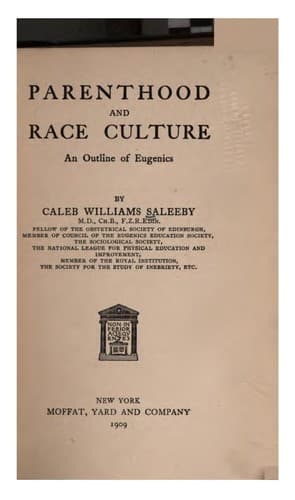
Parenthood and Race Culture: An Outline of EugenicsSaleeby, C. W. (Caleb Williams)
Philosophy
Parenthood and Race Culture: An Outline of Eugenics
Saleeby, C. W. (Caleb Williams)
Eugenics
[13] In his recent work, _The Origin of Vertebrates_, Dr. W. H.
Gaskell, F.R.S., has adduced much evidence in support of this thesis.
He says, “The law of progress is this: The race is not to the swift nor
to the strong, but to the wise.” And again; “As for the individual,
so for the nation; as for the nation, so for the race; the law of
evolution teaches that in all cases brain-power wins. Throughout, from
the dawn of animal life up to the present day, the evidence given in
this book suggests that the same law has always held. In all cases,
upward progress is associated with the development of the central
nervous system. The law for the whole animal kingdom is the same as for
the individual. ‘Success in this world depends upon brains.’”
[14] We may recall the words of Lear:--
“Is man no more than this? Consider him well: Thou owest the worm no
silk, the beast no hide, the sheep no wool, the cat no perfume:....
Thou art the thing itself: unaccommodated man is no more but such a
poor, bare, forked animal as thou art.”
[15] Says Darwin, “So little is this subject understood, that I have
heard surprise repeatedly expressed at such great monsters as the
Mastodon ... having become extinct; as if mere bodily strength gave
victory in the battle of life. Mere size, on the contrary, would in
some cases determine ... quicker extermination from the greater amount
of requisite food.” In the Russo-Japanese War, one of the effective
factors was the greater area of the Russian soldier as a target, and
the disparity between the food requirements of the little victors and
the big losers.
[16] Quoted from a Paper read by Mr. Galton before the Eugenics
Education Society, October 14, 1908, and published in _Nature_, October
22, 1908.
[17] See the author's paper, “The Psychology of Parenthood,” _Eugenics
Review_, April, 1909.
[18] An authoritative statement on this point has already been quoted
from Sir E. Ray Lankester's Romanes Lecture of 1905, p. 42.
[19] The exception of one or two large animals, like the elephant, is
not important. In proportion to body weight man's birth-rate is lower
than theirs. And it is to be noted that the “infant” mortality is very
low in this case, where the birth-rate is so low. Says Darwin, of the
young elephant. “None are destroyed by beasts of prey; for even the
tiger in India most rarely dares to attack a young elephant protected
by its dam.” The dam has no factory to go to, and no beast of prey to
sell her alcohol.
[20] “The fulmar petrel lays but one egg, yet it is believed to be
the most numerous bird in the world.” (_Origin of Species_, popular
edition, p. 81).
[21] _The Wheat Problem_, by Sir Wm. Crookes, F.R.S., 2nd edition,
1905. The _Chemical News_ Office, 15, Newcastle St., Farringdon St.,
E.C.
[22] See Chap. iii. of the _Origin of Species_.
Public-domain text, read in full here on John Shaqi.
Reviews
Reviews
No reviews yet
Be the first to share your thoughts on this work.
Elsewhere in the archive
Join the Discussion
Join the discussion
Sign in to leave a comment or review.
Sign InorCreate an account