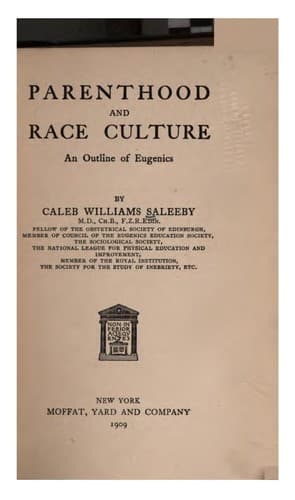
Parenthood and Race Culture: An Outline of EugenicsSaleeby, C. W. (Caleb Williams)
Philosophy
Parenthood and Race Culture: An Outline of Eugenics
Saleeby, C. W. (Caleb Williams)
Eugenics
[23] Including even such an exceptional student as Dr. George Newman,
who, in his book on _Infant Mortality_, regards a falling birth-rate
as an essential evil, and actually declares without qualification
that the factors “which lower the birth-rate tend to raise the infant
death-rate.”
[24] It is not necessary to point out again the exception of the
elephant, nor to explain it.
[25] Mr. Galton believes their number has been exaggerated.
[26] Quoted from the author's lectures on _Individualism and
Collectivism_ (Williams and Norgate, 1906).
[27] As is usually the case, except when the mother or the father is
alcoholic or syphilitic.
[28] If we make a diagram of society, with the social strata labelled,
and then proceed to make a eugenic comment upon it, certainly the
line dividing the sheep from the goats, _as for parenthood_, would
not be horizontal, at any level. Nor would it be vertical--as if the
proportions of worth and unworth were the same in all classes. Some
would draw it diagonally, counting most of the aristocracy good and
most of the lowest strata bad: others would slope it the other way.
I should not venture to draw it at all: there are individuals good
and bad in all classes and races, and their relative proportions are
unknown, at least to me.
[29] “For words are wise men's counters, they do but reckon by them;
but they are the money of fools” (Hobbes, _Leviathan_, Pt. I. chap iv.).
[30] It might be supposed that the words “inherent” and “inherited”
were allied etymologically. This is not so. “Inherit” is derived from
“heir,” and this from a verb meaning “to take.” In natural inheritance
the heir inherits what is inherent in the germ-cells which make him.
Says Professor Thomson: “The organisation of the fertilised ovum is the
inheritance”--_and the heir_, we may add.
[31] Unless indeed it be an organism so lowly as only to consist of one
cell throughout.
[32] The reader will remember the chapter, “A Berry to the Rescue.”
“Says Lucy demurely: ‘Now you know why I read history, and that sort
of books.... I only read sensible books and talk of serious things ...
because I have heard say ... dear Mrs. Berry! don't you understand
now?’”
[33] Contrast Mr. Galton, the propounder of the now accepted view:--
“As a general rule, with scarcely any exception that cannot be ascribed
to other influences, such as bad nutrition or transmitted microbes,
the injuries or habits of the parents are found to have no effect on
the natural form or faculties of the child.” (_Hereditary Genius_,
Prefatory Chapter to the Edition of 1892, p. xv.)
[34] In the later edition Mr. Galton discusses the question of the
title, and says that if it could now be altered, it should appear as
_Hereditary Ability_. We may note that, as the author says himself,
“The reader will find a studious abstinence throughout the work from
speaking of genius as a special quality.”
Public-domain text, read in full here on John Shaqi.
Reviews
Reviews
No reviews yet
Be the first to share your thoughts on this work.
Elsewhere in the archive
Join the Discussion
Join the discussion
Sign in to leave a comment or review.
Sign InorCreate an account