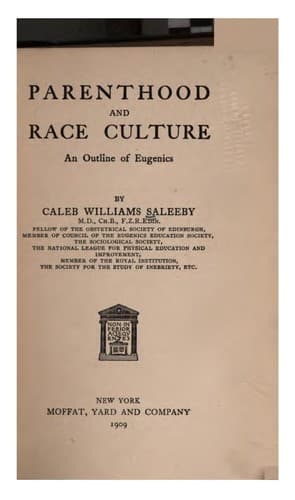
Parenthood and Race Culture: An Outline of EugenicsSaleeby, C. W. (Caleb Williams)
Philosophy
Parenthood and Race Culture: An Outline of Eugenics
Saleeby, C. W. (Caleb Williams)
Eugenics
[80] Gibbon does not enlighten us much on such vital matters: but my
attention has been called to the following passage, not irrelevant
here. It is from the _Attic Nights_ of Aulus Gellius, Book xii., chap.
i., written about A.D. 150--Gibbon's critical epoch. I use the free
translation of Mr. Quintin Waddington:--
“Once when I was with the philosopher Favorinus, word was brought to
him that the wife of one of his disciples had just given birth to a son.
“‘Let us go,’ said he, ‘to enquire after the mother, and to
congratulate the father.’ The latter was a noble of Senatorial rank.
“All of us who were present accompanied him to the house and went in
with him. Meeting the father in the hall, he embraced and congratulated
him, and, sitting down, enquired how his wife had come through the
ordeal. And when he heard that the young mother, overcome with fatigue,
was now sleeping, he began to speak more freely.
“‘Of course,’ said he, ‘she will suckle the child herself.’ And when
the girl's mother said that her daughter must be spared, and nurses
obtained in order that the heavy strain of nursing the child should
not be added to what she had already gone through, ‘I beg of you, dear
lady,’ said he, ‘to allow her to be a whole mother to her child. Is it
not against nature, and being only half a mother, to give birth to a
child, and then at once to send him away? To have nourished with her
own blood and in her own body a something that she had never seen,
and then to refuse it her own milk, now that she sees it living, a
human being, demanding a mother's care? Or are you one of those who
think that nature gave a woman breasts, not that she might feed her
children, but as pretty little hillocks to give her bust a pleasing
contour? Many indeed of our present-day ladies--whom you are far from
resembling--do try to dry up and repress that sacred fount of the body,
the nourisher of the human race, even at the risk they run from turning
back and corrupting their milk, lest it should take off from the charm
of their beauty. In doing this they act with the same folly as those,
who, by the use of drugs and so forth, endeavour to destroy the very
embryo in their bodies, lest a furrow should mar the smoothness of
their skin, and they should spoil their figures in becoming mothers.
If the destruction of a human being in its first inception, whilst it
is being formed, whilst it is yet coming to life, and is still in the
hands of its artificer, Nature, be deserving of public detestation and
horror, is it not nearly as bad to deprive the child of his proper
and congenial nutriment to which he is accustomed, now that he is
perfected, is born into the world, is a child?
“But it makes no difference--for as they say--so long as the child is
nourished and lives, with whose milk it is done.
Public-domain text, read in full here on John Shaqi.
Reviews
Reviews
No reviews yet
Be the first to share your thoughts on this work.
Elsewhere in the archive
Join the Discussion
Join the discussion
Sign in to leave a comment or review.
Sign InorCreate an account