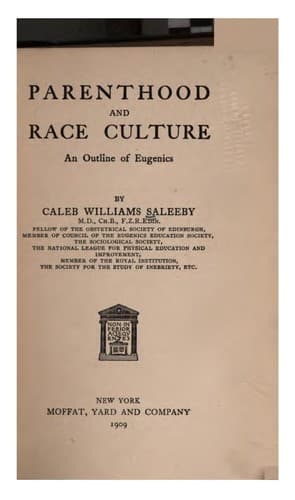
Parenthood and Race Culture: An Outline of EugenicsSaleeby, C. W. (Caleb Williams)
Philosophy
Parenthood and Race Culture: An Outline of Eugenics
Saleeby, C. W. (Caleb Williams)
Eugenics
“Why does he who says this, since he is so dull in understanding
nature, think it also of no consequence in whose womb and from whose
blood the child is formed and fashioned? For is there not now in
the breasts the same blood--whitened, it is true, by agration and
heat--which was before in the womb? And is not the wisdom of Nature
to be seen in this, that as soon as the blood has done its work of
forming the body down below, and the time of birth has come, it betakes
itself to the upper parts of the body, and is ready to cherish the
spark of life and light by furnishing to the new-born babe his known
and accustomed food? And so it is not an idle belief, that, just as the
strength and character of the seed have their influence in determining
the likeness of the body and mind, so do the nature and properties of
the milk do their part in effecting the same results. And this has
been noticed, not in man alone, but in cattle as well. For if kids are
brought up on the milk of ewes, or lambs on that of goats, it is agreed
that the latter have stiffer wool, the former softer hair. In the case
of timber and fruit trees, too, the qualities of the water and soil
from which they draw their nourishment have more influence in stunting
or augmenting their growth than those of the seed which is sewn, and
often you may see a vigorous and healthy tree when transplanted into
another place perish owing to the poverty of the soil.
“Is it then a reasonable thing to corrupt the fine qualities of
the new-born man, well endowed as to both body and mind so far as
parentage is concerned, with the unsuitable nourishment of degenerate
and foreign milk? Especially is this the case, if she whom you get
to supply the milk is a slave or of servile estate, and--as is very
often the case--of a foreign and barbarous race, if she is dishonest,
ugly, unchaste, or _addicted to drink_. For generally any woman who
happens to have milk is called in, without further enquiry as to her
suitability in other respects. Shall we allow this babe of ours to be
tainted by pernicious contagion, and to draw life into his body and
mind from a body and mind debased?
"This is the reason why we are so often surprised that the children of
chaste mothers resemble their parents neither in body nor character.
“... And besides these considerations, who can afford to ignore or
belittle the fact that those who desert their offspring and send them
away from themselves, and make them over to others to nurse, cut, or at
least loosen and weaken that chain and connection of mind and affection
by which Nature attaches children to their parents. For when the child,
sent elsewhere, is away from sight, the vigour of maternal solicitude
little by little dies away, and the call of motherly instinct grows
silent, and forgetfulness of a child sent away to nurse is not much
less complete than that of one lost by death.
Public-domain text, read in full here on John Shaqi.
Reviews
Reviews
No reviews yet
Be the first to share your thoughts on this work.
Elsewhere in the archive
Join the Discussion
Join the discussion
Sign in to leave a comment or review.
Sign InorCreate an account