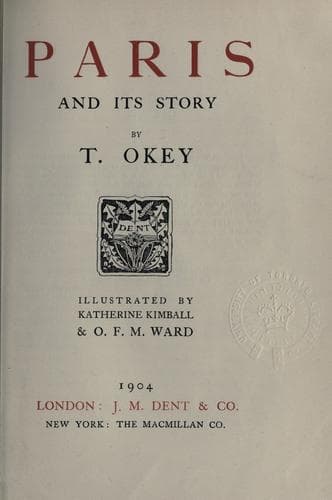
Paris (France) -- Description and travel; Paris (France) -- History
In this palace the great minister--busy with a yet vaster scheme for
building an immense Place Ducale, north of the palace--passed away
leaving its stately magnificence to the king, whose widow, Anne of
Austria, inhabited it during the regency with her sons, Louis XIV. and
Philip Duke of Orleans, the founder of the Bourbon-Orleans family. The
famous architect, François Mansard, was employed by her to extend the
Palais Royal as it was then called, which subsequently became infamous
as the scene of the orgies of Philip's son during his regency. The
buildings were further extended by Philip Egalité, who destroyed the
superb plantation of chestnut trees and erected shops along the sides of
the gardens, which as _cafés_ and gambling-saloons became a haunt of
fashionable vice and dissipation in the late eighteenth century. The
gardens of the royal palaces had always been open to well-dressed
citizens, but notices forbade entrance to beggars, servants, and all
ill-clad persons under pain of imprisonment, the carcan, and other
graver penalties. Egalité, however, to win popularity, opened his
gardens without restriction, and they soon became the forum of the
revolutionary agitation. Here Camille Desmoulins declaimed his
impassioned orations and called Paris to arms. The gambling-hells, of
which there were over three hundred, survived the Revolution, and
Blucher and many an officer of the allied armies lost immense sums
there. The Palais Royal became subsequently the residence of the Orleans
family, and now serves as the meeting-place of the Conseil d'Etat.
Public-domain text, read in full here on John Shaqi.
Reviews
Reviews
No reviews yet
Be the first to share your thoughts on this work.
Elsewhere in the archive
Join the Discussion
Join the discussion
Sign in to leave a comment or review.
Sign InorCreate an account