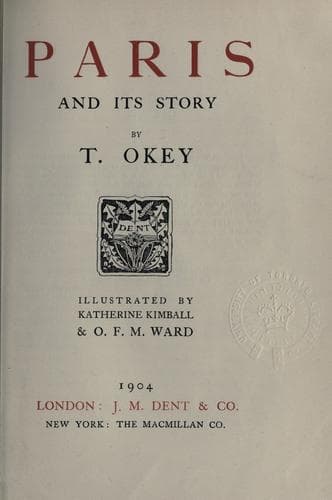
Paris (France) -- Description and travel; Paris (France) -- History
In the early seventeenth century nine lovers of literature associated
themselves for the purpose of holding a friendly symposium, where they
discoursed of books, and read and criticised each other's compositions;
the meetings were followed by a modest repast and a peripatetic
discussion. The masterful cardinal, who would rule the French language
as well as the state, called the nine together, and in 1635 organised
them into an Académie Française, whose function should be to perfect and
watch over the purity of the French tongue. The Parlement granted
letters-patent, limited the number of academicians to forty, and
required them to take cognisance of French authors and the French
language alone. The original nine, however, were far from gratified, and
always regretted the "golden age" of early days. Richelieu established
the Jardin des Plantes for the use of medical students, where
demonstrations in botany were given; he rebuilt the college and church
of the Sorbonne where his monument,[129] a masterpiece of sculpture by
Girardon from Lebrun's designs, may still be seen. He cheapened the
postal service,[130] established the Royal Press at the Louvre which in
twenty years published seventy Greek, Latin, Italian and French
classics. He issued the first political weekly gazette in France, was a
liberal patron of men of letters and of artists, and saw the birth and
fostered the growth of the great period of French literary and artistic
supremacy.
Another of Henry the Fourth's plans for the aggrandisement of Paris was
carried out by the indefatigable minister. As early as 867 the bishops
of Paris had been confirmed by royal charter in their possession of the
two islands east of the Cité, the Isle Notre Dame and Isle aux Vaches.
From time immemorial these had been used as timber-yards, and in 1616
the chapter of the cathedral was induced to treat with Christophe Marie,
contractor for the bridges of France and others, who agreed to fill in
the channel,[131] which separated the islands; to cover them with broad
streets of houses and quays, and to build certain bridges; but expressly
contracted never to fill up the arm of the Seine between the Isle Notre
Dame, and the Cité. The first stone of the new bridge which was to
connect the islands with the north bank was laid by Louis XIII. in 1614
and named Pont Marie, after the contractor. In 1664 a church, dedicated
to St. Louis, was begun on the site of an earlier chapel by Levau, but
not completed until 1726 by Donat.
Public-domain text, read in full here on John Shaqi.
Reviews
Reviews
No reviews yet
Be the first to share your thoughts on this work.
Elsewhere in the archive
Join the Discussion
Join the discussion
Sign in to leave a comment or review.
Sign InorCreate an account