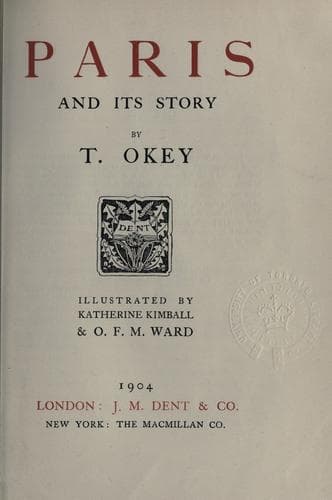
Paris (France) -- Description and travel; Paris (France) -- History
Of Vouet (1590-1649), who is important as the leader of the new French
school of the seventeenth century, the Louvre has some dozen examples,
among them being his masterpiece (No. 971)--The Presentation at the
Temple. Bestowing a passing attention on the lesser masters, and pausing
to appreciate the works of the three brothers Le Nain, who stand
pre-eminent for the healthy, sturdy simplicity of their peasant types
and scenes of lowly life, we turn to Nicolas Poussin (1594-1665), the
greatest of the seventeenth-century masters, who spent the whole of his
artistic career in Rome save two unhappy years (1640-1642) at the French
court, which his simple habits and artistic conscience made intolerable
to him. His exalted and lucid conceptions, admirable art and fertility
of invention may be adequately appreciated at the Louvre alone, which
holds nearly fifty examples of his work. The beautiful and pathetic
Shepherds of Arcady (No. 734) is generally regarded as his masterpiece.
A group of shepherds in the fulness of health and beauty are arrested in
their enjoyment of life by the warning inscription on a tomb--"_Et in
arcadia ego_" ("I, too, once lived in Arcady"). Equally rich is the
Louvre in works of Vouet's pupil, Lesueur (1617-1655), one of the twelve
ancients of the Royal Academy of Painting and Sculpture. No greater
contrast could be imagined to the frank paganism of Poussin than the
works of this fervently religious and tender artist, whose famous series
from the life of St. Bruno is now placed in Room XII. His careful
application to this monumental task may be estimated by the fact that
146 preliminary studies are preserved in the cabinet of drawings in the
Louvre. The decorative skill, fertility and industry of his contemporary
and fellow-pupil Lebrun (1617-1690), whom Louis XIV. loved to patronise,
may perhaps be better appreciated at Versailles, but the Louvre displays
the celebrated series of the Life of Alexander, executed for the
Gobelins, and some score of his other works. His less talented rival,
Mignard (1612-1695), also a pupil of Vouet, is seen at his best in the
frescoes of the dome[173] of the Val de Grâce, but the oppressive
influence of the Italian eclectics is all too evident in his style. He
excelled in portraiture, and the visitor will not fail to remark the
portraits of Madame de Maintenon, and of the Grand Dauphin with his wife
and children. Louis XIV., who sat to him many times, one day, towards
the end of his life, asked, "Do you find me changed?" "Sire," answered
the courtly painter, "I only perceive a few more victories on your
brow." We may now observe the more grave and virile style of Philippe de
Champaigne of Brussels (1602-1674), who settled in Paris at nineteen
years of age, and may fairly be classed among the French school. His
intimate association with the austere and pious Jansenists of Port Royal
is traceable in the Last Supper (No. 1928), and in his masterpiece, the
Public-domain text, read in full here on John Shaqi.
Reviews
Reviews
No reviews yet
Be the first to share your thoughts on this work.
Elsewhere in the archive
Join the Discussion
Join the discussion
Sign in to leave a comment or review.
Sign InorCreate an account