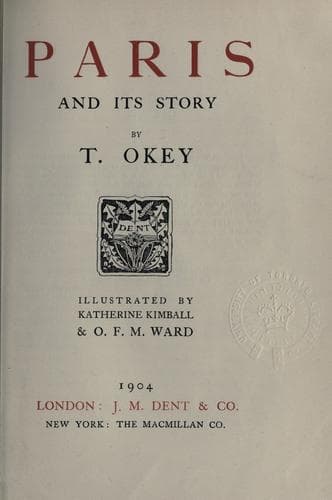
Paris (France) -- Description and travel; Paris (France) -- History
portraits of Mother Catherine Agnes Arnauld and his own daughter, Sister
Catherine (No. 1934), painted for the famous convent. He is perhaps
better known for his portraits of Richelieu. Claude Lorrain (1600-1682),
the best known and most appreciated of the seventeenth-century masters,
and the greatest of the early landscape painters, is seen in sixteen
examples.
[Illustration: LANDING OF CLEOPATRA AT TARSUS.
CLAUDE LORRAIN.]
[Illustration: A SEAPORT.
CLAUDE LORRAIN.]
Rarely has the numbing and corrupting influence of royal patronage of
art been more clearly demonstrated than in the group of painters who
interpreted the hollow state, the sensuality and the more pleasant vices
of the courts of Louis XIV., of the Regency, and of Louis XV. But
among them, yet not of them, Watteau (1641-1721) stands alone--Watteau
the melancholy youth from French Flanders, who invented a new manner of
painting, and became known as the _Peintre des Scènes Galantes_. These
scenes of coquetry, frivolity and amorous dalliance, with their patched,
powdered and scented ladies and gallants, toying with life in a land
where, like that of the Lotus Eaters, it seems always afternoon, he
clothes with a refined and delicate vesture of grace and fascination. He
has a poetic touch for landscape and a tender, pathetic sense of the
tears in mortal things which make him akin to Virgil in literature, for
over the languorous and swooning air and sun-steeped glades the coming
tempest lours. His success, as Walter Pater suggests, in painting these
vain and perishable graces of the drawing-room and garden comedy of life
with the delicate odour of decay which rises from the soil, was probably
due to the fact that he despised them. The whole age of the Revolution
lies between these irresponsible and gay courtiers in the _scènes
galantes_ of Watteau and the virile peasant scenes in the "epic of toil"
painted by Millet. Among the dozen paintings by Watteau in the Louvre
may be especially noted his Academy picture, the Embarkation for Cythera
(No. 982). His pupils, Pater and Lancret, imitated his style, but were
unable to soar to the higher plane of their master's idealising spirit.
Public-domain text, read in full here on John Shaqi.
Reviews
Reviews
No reviews yet
Be the first to share your thoughts on this work.
Elsewhere in the archive
Join the Discussion
Join the discussion
Sign in to leave a comment or review.
Sign InorCreate an account