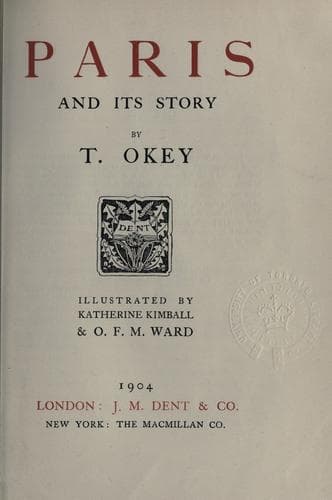
Paris (France) -- Description and travel; Paris (France) -- History
To the south of the Champs Elysées is the Cours de la Reine, planted by
Catherine de' Medici, for two years the most fashionable carriage drive
in Paris. The charming Maison François I. brought from Moret, stone by
stone, in 1826 stands re-erected at the further corner of the Cours. To
the north, in the Cours de Gabriel, a fine gilded grille, surmounted
with the arms of the Republic, gives access to the Elysée, the official
residence of the President. It was once Madame Pompadour's favourite
house in Paris, and the piece of land she appropriated from the public
to round off her gardens is still retained in its grounds. In the Avenue
Montaigne (once the Allée des Veuves, a retired walk used by widows
during their term of seclusion) Nos. 51 and 53 stand on the site of the
notorious Bal Mabille,[176] the temple of the bacchanalia of the gay
world of the Second Empire. In 1764 the Champs Elysées ended at
Chaillot, an old feudal property which Louis XI. gave to Phillipe de
Comines in 1450, and which in 1651 sheltered the unhappy widow of
Charles I. Here Catherine de' Medici built a château, but château and a
nunnery of the Filles de Sainte Marie, founded by the English queen,
disappeared in 1790. As we descend the Rue de Chaillot and pass the
Trocadero we see across the Pont de Jéna the gilded dome of the
Invalides and the vast field of Mars, the scene of the Feast of Pikes,
and now encumbered by the relics of four World's Fairs.
[Illustration: LICTORS BRINGING TO BRUTUS THE BODIES OF HIS SONS.
DAVID.]
Public-domain text, read in full here on John Shaqi.
Reviews
Reviews
No reviews yet
Be the first to share your thoughts on this work.
Elsewhere in the archive
Join the Discussion
Join the discussion
Sign in to leave a comment or review.
Sign InorCreate an account