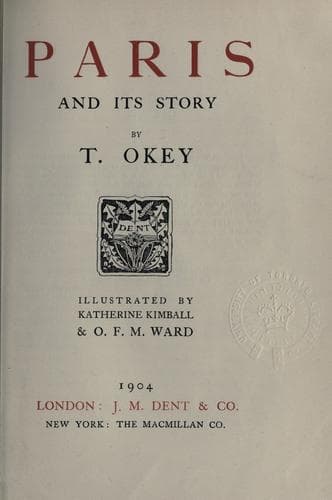
Paris (France) -- Description and travel; Paris (France) -- History
The Paris we have rapidly surveyed is, mainly, enclosed by the inner
boulevards, which correspond to the ramparts of Louis XIII. on the north
demolished by his successor between 1676 and 1707, and the line of the
Philip Augustus wall and the Boulevard St. Germain on the south. Beyond
this historic area are the outer boulevards which mark the octroi wall
of Louis XVI.; further yet are the Thiers wall and fortifications of
1841. Within these wider boundaries is the greater Paris of the
nineteenth and twentieth centuries, of profound concern to the
economical and social student, but of minor interest to the ordinary
traveller. The vogue of the brilliant and gay inner boulevards of the
north bank so familiar to the foreigner in Paris is of comparatively
recent growth. In the early nineteenth century the boulevard from the
Place de la Madeleine to the Rue Cambon was almost deserted by day and
dangerous by night--a vast waste, the proceeds of the confiscated lands
of the Filles de la Conception. About the same time the fashionable
cafés were migrating from the Palais Royal to the Boulevard des
Italiens, south of which was built the Theatre of the Comédie Italienne,
afterwards known as the Opéra Comique. Its façade was turned away from
the boulevard lest the susceptible artists should be confounded with the
ordinary "comediens of the boulevard." From the Boulevard Montmartre to
the Boulevard St. Martin followed lines of private hotels, villas,
gardens and convent walls. A great mound which separated the Boulevard
St. Martin from the Boulevard du Temple still existed, and was not
cleared away until 1853. From 1760 to 1862 the Boulevard du Temple was a
centre of pleasure and amusement, where charming suburban houses and
pretty gardens alternated with cheap restaurants, hotels, theatres,
cafés, marionette shows, circuses, tight-rope dancers, waxworks, and
cafés-chantants. In 1835, so lurid were the dramas played there, that
the boulevard was popularly known as the _Boulevard du Crime_. But the
expression of the dramatic and musical genius and social life of the
Parisians in their higher forms is of sufficient importance to merit a
concluding chapter.
CHAPTER XX
THE COMÉDIE FRANÇAISE--THE OPÉRA--SOME FAMOUS CAFÉS--CONCLUSION
Public-domain text, read in full here on John Shaqi.
Reviews
Reviews
No reviews yet
Be the first to share your thoughts on this work.
Elsewhere in the archive
Join the Discussion
Join the discussion
Sign in to leave a comment or review.
Sign InorCreate an account