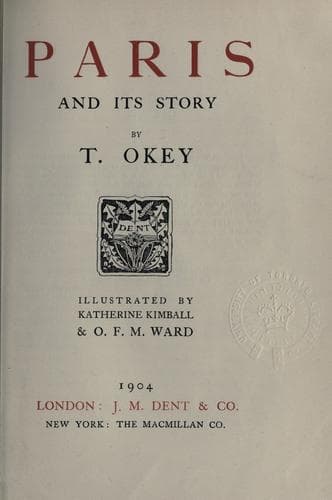
Paris (France) -- Description and travel; Paris (France) -- History
The treasurers of the Basoche were charged with the cost of the annual
planting of the May tree in the Cour du Mai of the Palais. Towards the
end of May the procession of the Basoche wended its way to the Forest of
Bondy, where halt was made under the _Orme aux harangues_ (elm of the
speeches). Here their procureur made an oration, and demanded from the
officer of woods and forests two trees of his own choice in the king's
name, which were carried to Paris amid much playing of drums and fifes
and trumpets. On the last Saturday in May the ceremony of the planting
took place in the court of the palace, the preceding year's tree,
standing to the right of the entrance, was felled and removed, and the
more flourishing of the two brought from the forest was planted in its
stead.
Anne of Austria, to whom Molière dedicated one of his plays, was so
devoted an admirer of the theatre that even during the period of court
mourning for her royal husband she was unable to renounce her favourite
pleasure and witnessed the plays at the Palais Royal concealed behind
her ladies. Mazarin, courtier that he was, flattered her passion for the
drama by introducing a company of Italian opera-singers, who in 1647
performed _La Finta Pazza_ at the Hôtel de Bourbon.
The new entertainment met with instant success, and the French were
spurred to emulation by the music and voices of the foreign performers.
Anne's music masters, Lambert and Cambert, set to music a piece written
by the Abbé Perrin, who was attached to the court of the Duke of
Orleans, and this musical comedy was performed with brilliant success
before the young king at Vincennes. Encouraged by Mazarin, Perrin and
Cambert joined the Marquis of Sourdeac, a clever mechanician, and
obtained permission in 1669 to open an Academy of Music, for so the new
venture was called, and works were performed which vied in attraction
with those of the Italians. Perrin now obtained the sole privilege of
producing operas in Paris and other French towns, and in 1671-1672 we
find the _entrepreneurs_ giving performances of _Pomone_ among other
"_Comédies Françaises en Musique_" in the theatre of the Hôtel de
Guénégaud. Perrin having disagreed with his partners, the privilege of
performing opera was next transferred to a young Italian musician named
Lulli, who had entered the service of Mademoiselle (daughter of the Duke
of Orleans) as a kitchen boy, but having developed an extraordinary
aptitude for the violin was put under a master, and became one of the
greatest performers of the day. He entered the king's service, won the
protection of Madame de Montespan, and so charmed Louis by his talents
that his fortune was assured. Lulli's works were first given at the
Tennis Court of Bel-air, in the Rue Vaugirard, and a clause having been
inserted in the charter permitting the nobles of the court to take part
in the representations without derogation, a performance of _Love and
Public-domain text, read in full here on John Shaqi.
Reviews
Reviews
No reviews yet
Be the first to share your thoughts on this work.
Elsewhere in the archive
Join the Discussion
Join the discussion
Sign in to leave a comment or review.
Sign InorCreate an account