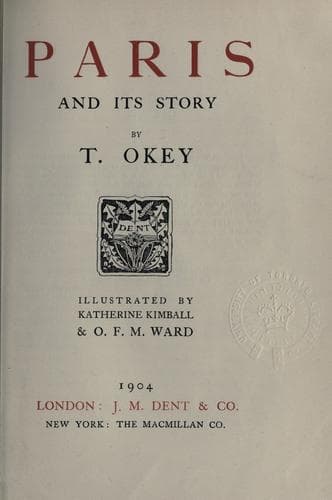
Paris (France) -- Description and travel; Paris (France) -- History
Bacchus_ was given before the king in which the Duke of Monmouth was
associated with seven French nobles.
When Molière's company of comedians left the theatre of the Palais Royal
in 1673, Lulli's "Academy" was established in their place, and the
Palais Royal Theatre became the Royal Opera House until 1787, with an
interval caused by the rebuilding after the fire of 1763. In 1697 the
Italians were forbidden to perform any more in Paris, and French opera
enjoyed a monopoly of royal favour, until the Regent recalled the
Italians in 1716.
The Académie de Musique, or French Opera, subsequently migrated to the
Salle d'Opéra, at the Hôtel Louvois, on the site of the present Square
Louvois. It was in this house that the Duke of Berri was assassinated in
1820. The Government decreed the demolition of the building, and an
opera house was hurriedly erected in the Rue Lepelletier. This
inconvenient, stuffy Hall of the Muses, so familiar to the older
generation of opera-goers, was at length superseded by the present
luxurious temple in 1874.
[Illustration: ARC DE TRIOMPHE.]
The early French operas were of the nature of elaborate ballets, based
invariably on mythological subjects, and, indeed, the ballet up to
recent times, when the reforming influence of Wagner's music-dramas made
itself felt, has always formed the more important part of every operatic
performance. Only when the curtain rose on the _scènes de ballet_ did
chatter cease, for as Taine remarked, "_Le public ne se trouve
émoustillé que par le ballet_" ("The public only brightens up at the
ballet"), and the traditional habit of Society was expressed in the
formula, "_On n'écoute que le ballet_" ("One only listens to the
ballet"). Molière wrote a tragédie-ballet, a pastorale heroique, a
pastorale comique, and eight comédies-ballets, in one of which, _Le
Sicilian_, the king himself, the Marquis of Villeroi and other courtiers
performed with Molière and his daughter. In 1681 the permission already
given to the princes and other nobles to take part in the ballets
without derogation was extended to the ladies of the court, who in
that year performed the _Triomphe de l'Amour_. The innovation proved
most successful, and soon affected the public stage, where, as at the
court, up to that period male performers alone were tolerated. Mdlle. de
la Fontaine was the first of the famous _danseuses_ of the Paris opera,
and her portrait, with those of some score of her successors, still
adorn the _foyer de la danse_. The opera was a social rather than a
musical function, and the old _foyer_, until the fall of the Second
Empire, was the favourite meeting-place during the season of royal and
distinguished personages, courtiers, ministers, ambassadors, and,
indeed, of all French society of the male persuasion. Such was the
passion for the opera during the reign of Louis XVI. that fashionable
devotees would journey from Brussels to Paris in time to see the curtain
Public-domain text, read in full here on John Shaqi.
Reviews
Reviews
No reviews yet
Be the first to share your thoughts on this work.
Elsewhere in the archive
Join the Discussion
Join the discussion
Sign in to leave a comment or review.
Sign InorCreate an account